UPPCS Syllabus 2026 PDF Download – Prelims & Mains Latest Subject-wise Syllabus
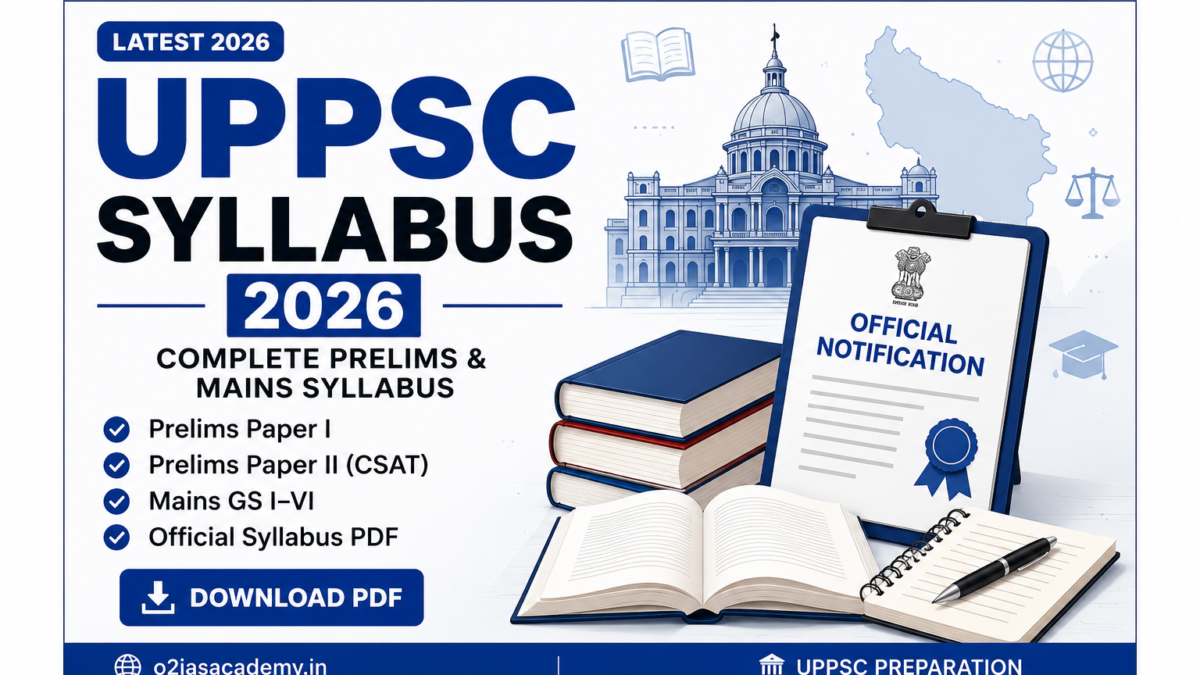
UPPCS Syllabus 2026 PDF Download – Complete Prelims & Mains Syllabus
Preparing for the Uttar Pradesh PCS Examination begins with understanding the complete syllabus. Whether you're starting your preparation or revising strategically, knowing every topic prescribed by the Uttar Pradesh Public Service Commission (UPPSC) helps you study with confidence and avoid unnecessary distractions.
On this page, you'll find the latest UPPSC Syllabus 2026 for both the Preliminary and Main examinations, along with the updated exam pattern, selection process, important preparation tips, and downloadable syllabus PDFs. The syllabus sections have been presented exactly as prescribed by UPPSC, while the explanations are written in simple language to help aspirants understand what to prepare.
UPPCS Syllabus 2026 Overview
The Uttar Pradesh Public Service Commission conducts the Combined State/Upper Subordinate Services (PCS) Examination every year to recruit officers for various administrative posts in the state government. The examination follows a three-stage selection process consisting of the Preliminary Examination, Main Examination, and Interview.
While the Preliminary Examination serves as a screening stage, the Main Examination and Interview determine the final merit list. Therefore, candidates should understand the syllabus of every paper before beginning their preparation.
| Exam Name | UPPCS PCS Examination 2026 |
|---|---|
| Conducting Body | Uttar Pradesh Public Service Commission (UPPSC) |
| Level | State Level Competitive Examination |
| Selection Process | Prelims → Mains → Interview |
| Mode of Examination | Offline |
| Official Language | Hindi & English |
UPPCS Selection Process 2026
The UPPSC PCS recruitment process is conducted in three successive stages. Candidates must qualify each stage to proceed to the next one. Although the Preliminary Examination is qualifying in nature, clearing it is mandatory to become eligible for the Main Examination.
Stage 1
Preliminary Examination
The first stage consists of two objective-type papers. Only the marks obtained in General Studies Paper I are considered for qualifying to the Main Examination, while CSAT is qualifying in nature.
Stage 2
Main Examination
Candidates who qualify the Preliminary Examination appear for the descriptive Main Examination consisting of eight papers. Marks obtained here play a major role in the final merit list.
Stage 3
Interview
The final stage assesses a candidate's personality, communication skills, administrative aptitude, decision-making ability, and overall suitability for public service.
Talk to a Teacher
Have questions about the UPPSC syllabus, exam pattern, preparation strategy, or choosing the right course? Speak directly with our expert faculty and get personalized guidance.
📞 Talk to a TeacherUPPCS Prelims Syllabus 2026
The Preliminary Examination is designed to shortlist candidates for the Main Examination. It contains two objective-type papers conducted on the same day. While General Studies Paper I determines eligibility for the next stage, General Studies Paper II (CSAT) is only qualifying and requires a minimum qualifying score as prescribed by the Commission.
Marks obtained in the Preliminary Examination are not included while preparing the final merit list. However, qualifying this stage is compulsory to appear for the Main Examination.
UPPCS Prelims Paper I – General Studies Syllabus
General Studies Paper I evaluates a candidate's awareness of current affairs, history, geography, governance, economy, environment, and general science. It forms the basis of merit in the Preliminary Examination.
Paper I – General Studies I
Official UPPSC Prelims Paper I Syllabus
- Current Events of National and International Importance.
- History of India and the Indian National Movement.
- India and World Geography – Physical, Social and Economic Geography of India and the World.
- Indian Polity and Governance – Constitution, Political System, Panchayati Raj, Public Policy, Rights Issues, etc.
- Economic and Social Development – Sustainable Development, Poverty, Inclusion, Demographics, Social Sector Initiatives, etc.
- General Issues on Environmental Ecology, Biodiversity and Climate Change that do not require subject specialization.
- General Science.
Topic-wise Explanation
Current Events of National and International Importance
Candidates should stay updated with important national and international developments. Questions are generally based on significant events, government initiatives, international organisations, reports, awards, sports, science, technology, and other contemporary issues.
History of India & Indian National Movement
The focus is on developing a broad understanding of India's historical, political, social, and economic developments. Candidates should also study the freedom movement, the growth of nationalism, important leaders, and India's struggle for independence.
India and World Geography
This section covers the physical, social, and economic geography of both India and the world. Questions may relate to climate, rivers, mountains, natural resources, agriculture, industries, population, and geographical features.
Indian Polity and Governance
Candidates are expected to understand the Constitution of India, political system, Panchayati Raj institutions, governance, public policies, constitutional bodies, and important rights-related issues.
Economic and Social Development
Preparation should include sustainable development, poverty, inclusive growth, demographic trends, government welfare schemes, urbanisation, social sector initiatives, and the relationship between population, environment, and development.
Environmental Ecology, Biodiversity & Climate Change
Questions test general awareness of environmental conservation, biodiversity, ecological balance, pollution, climate change, and related national and international initiatives. No specialised scientific background is required.
General Science
General Science focuses on everyday scientific concepts and observations. Candidates should understand basic principles of Physics, Chemistry, Biology, space science, health, and technology from a general awareness perspective.
Candidates are expected to have general awareness of all the above subjects with special reference to Uttar Pradesh. Along with national-level preparation, aspirants should also stay updated on important events, schemes, geography, history, economy, and governance related to Uttar Pradesh.
Looking for the complete topic-wise UPPCS Prelims Paper I syllabus? View the detailed official syllabus along with every topic prescribed by the Uttar Pradesh Public Service Commission.
📄 View Detailed Paper I SyllabusUPPCS Prelims Paper II (CSAT) Syllabus
The Civil Services Aptitude Test (CSAT) measures a candidate's reasoning ability, analytical skills, decision-making, comprehension, and basic numerical aptitude. Although this paper is qualifying in nature, candidates should prepare it seriously to comfortably meet the qualifying requirement.
UPPCS Prelims Paper II (CSAT) Syllabus 2026
General Studies Paper II, commonly known as the Civil Services Aptitude Test (CSAT), evaluates a candidate's analytical thinking, logical reasoning, comprehension, decision-making ability, and basic numerical aptitude. Unlike Paper I, this paper is qualifying in nature. Candidates must secure the minimum qualifying marks prescribed by the Commission to become eligible for the Main Examination.
Paper II (CSAT) is a qualifying paper. Candidates are required to score at least 33% marks to qualify. Although its marks are not included in the final merit list, failing to qualify will result in disqualification from the Preliminary Examination.
Official UPPCS CSAT Syllabus
- Comprehension.
- Interpersonal Skills including Communication Skills.
- Logical Reasoning and Analytical Ability.
- Decision Making and Problem Solving.
- General Mental Ability.
- Elementary Mathematics (Class X Level).
- General English (Class X Level).
- General Hindi (Class X Level).
What Does CSAT Test?
The objective of the CSAT paper is to assess whether candidates possess the aptitude and problem-solving abilities required for administrative responsibilities. Instead of testing factual knowledge, this paper focuses on understanding, analysis, reasoning, and decision-making skills. Regular practice of previous year papers and mock tests is the most effective way to improve performance in CSAT.
Want to explore the detailed official CSAT syllabus with complete topic-wise coverage and important areas for preparation?
📄 View Detailed CSAT SyllabusUPPCS Mains Syllabus 2026
The UPPCS Main Examination is the most important stage of the recruitment process as its marks are considered for preparing the final merit list. Unlike the Preliminary Examination, the Mains consists of descriptive papers that evaluate a candidate's analytical ability, conceptual understanding, writing skills, and knowledge of national as well as Uttar Pradesh-specific issues.
The examination comprises eight descriptive papers, including General Hindi, Essay, and six General Studies papers. Candidates are expected to present well-structured, factual, and analytical answers within the prescribed word limit.
The optional subject has been removed from the UPPCS Main Examination. Instead, two compulsory General Studies papers focusing on Uttar Pradesh have been introduced as General Studies Paper V and General Studies Paper VI.
UPPCS Mains Paper Structure
| Paper | Subject | Marks |
|---|---|---|
| Paper I | General Hindi | 150 |
| Paper II | Essay | 150 |
| Paper III | General Studies I | 200 |
| Paper IV | General Studies II | 200 |
| Paper V | General Studies III | 200 |
| Paper VI | General Studies IV | 200 |
| Paper VII | General Studies V (Uttar Pradesh Special) | 200 |
| Paper VIII | General Studies VI (Uttar Pradesh Special) | 200 |
| Total Marks | 1500 | |
General Hindi
The General Hindi paper evaluates a candidate's command over the Hindi language and writing skills. Questions generally assess grammar, vocabulary, comprehension, précis writing, translation, sentence correction, and effective expression. Regular practice of formal Hindi writing and grammar is essential for scoring well in this paper.
Essay Paper
The Essay paper measures a candidate's ability to organise thoughts logically and present balanced, well-supported arguments. Essays may be based on social, political, economic, scientific, environmental, philosophical, or Uttar Pradesh-related themes. Candidates should focus on clarity, structure, factual accuracy, and balanced analysis while writing essays.
General Studies Paper I
General Studies Paper I focuses on Indian heritage, culture, history, society, and geography. The paper requires conceptual understanding along with the ability to connect historical and geographical developments with contemporary issues.
Major Areas Covered
- Indian Heritage and Culture
- Ancient, Medieval and Modern Indian History
- Freedom Struggle
- World History
- Indian Society
- Women and Social Issues
- Globalisation and Social Change
- Physical Geography
- Natural Resources
- Population and Urbanisation
General Studies Paper II
General Studies Paper II mainly focuses on governance, the Constitution, public administration, social justice, and international relations. Candidates should have a clear understanding of constitutional provisions and current governance-related developments.
Major Areas Covered
- Indian Constitution
- Parliament and State Legislature
- Executive and Judiciary
- Federal Structure
- Governance
- Public Policy
- Welfare Schemes
- NGOs and SHGs
- International Relations
- Current Affairs
General Studies Paper III
General Studies Paper III focuses on India's economy, agriculture, science and technology, environment, disaster management, and internal security. The paper evaluates a candidate's understanding of contemporary economic issues, technological developments, sustainable growth, and national security challenges. Aspirants should regularly follow current affairs along with standard reference books to perform well in this paper.
Major Areas Covered
- Indian Economy and Planning
- Poverty, Inclusive Growth and Employment
- Government Budgeting
- Agriculture and Food Processing
- Infrastructure Development
- Science & Technology
- Information and Communication Technology
- Environmental Conservation
- Disaster Management
- Internal Security and Cyber Security
General Studies Paper IV
General Studies Paper IV assesses a candidate's ethical values, integrity, aptitude, emotional intelligence, and decision-making ability. Unlike factual subjects, this paper tests how candidates apply ethical principles in real-life administrative situations. Regular practice of case studies and answer writing can significantly improve performance.
Major Areas Covered
- Ethics and Human Values
- Attitude
- Aptitude and Integrity
- Emotional Intelligence
- Contributions of Moral Thinkers
- Public Administration Ethics
- Probity in Governance
- Case Studies
General Studies Paper V (Uttar Pradesh Special)
General Studies Paper V is dedicated entirely to Uttar Pradesh. It examines a candidate's knowledge of the state's history, culture, governance, economy, administration, tourism, education, health, and current affairs. Since this paper is state-specific, candidates should pay special attention to government reports, state schemes, and Uttar Pradesh current affairs.
Major Areas Covered
- History and Culture of Uttar Pradesh
- Freedom Movement in UP
- Political System of Uttar Pradesh
- Panchayati Raj and Local Governance
- Law & Order
- Health and Education
- Tourism
- Current Affairs of Uttar Pradesh
- Government Schemes
- Innovation and Development
General Studies Paper VI (Uttar Pradesh Special)
General Studies Paper VI focuses on Uttar Pradesh's economy, geography, agriculture, industries, natural resources, environmental issues, science and technology, infrastructure, and government policies. A thorough understanding of state-specific development indicators and economic initiatives is essential for scoring well.
Major Areas Covered
- Economy of Uttar Pradesh
- Trade and Industry
- Government Schemes
- Agriculture and Forestry
- Geography of Uttar Pradesh
- Natural Resources
- Infrastructure Development
- Pollution and Climate Change
- Science & Technology
- Public-Private Partnership (PPP)
UPPCS Exam Pattern 2026
Understanding the UPPCS Exam Pattern is just as important as knowing the syllabus. It helps candidates plan their preparation effectively, manage time during the examination, and understand how marks are calculated at each stage of the selection process. The examination is conducted in three phases: Preliminary Examination, Main Examination, and Interview.
UPPCS Prelims Exam Pattern
| Particular | Details |
|---|---|
| Mode of Examination | Offline (OMR Based) |
| Type of Questions | Objective (Multiple Choice Questions) |
| Number of Papers | 2 |
| Paper I | General Studies I (200 Marks) |
| Paper II | General Studies II (CSAT) – 200 Marks (Qualifying) |
| Negative Marking | Yes (1/3rd mark deducted for each incorrect answer) |
| Merit Calculation | Only Paper I marks are considered |
| CSAT Requirement | Minimum 33% Qualifying Marks |
UPPCS Mains Exam Pattern
| Paper | Marks |
|---|---|
| General Hindi | 150 |
| Essay | 150 |
| General Studies I | 200 |
| General Studies II | 200 |
| General Studies III | 200 |
| General Studies IV | 200 |
| General Studies V | 200 |
| General Studies VI | 200 |
| Total | 1500 Marks |
Download UPPCS Syllabus 2026 PDF
Download the latest UPPCS Prelims and Mains syllabus PDF and keep it handy throughout your preparation. Referring to the official syllabus regularly helps you stay focused on the prescribed topics and avoid unnecessary study material.
Official Notification
Refer to the official UPPSC notification released by the Uttar Pradesh Public Service Commission for complete details regarding the examination.
📄 Official NotificationHow to Prepare the UPPCS Syllabus Effectively?
Completing the syllabus is only the first step. Success in the UPPSC examination depends on understanding concepts, consistent revision, answer writing practice, and staying updated with current affairs. Candidates should prepare according to the weightage of each paper and regularly evaluate their performance through mock tests.
Follow the Official Syllabus
Always use the official syllabus as your primary guide while selecting study material and preparing your timetable.
Build Strong Fundamentals
Develop conceptual clarity using NCERT books and standard reference sources before moving to advanced material.
Revise Regularly
Revision helps retain important facts, improves recall during the examination, and strengthens weak topics.
Practice Answer Writing
For the Main Examination, regular answer writing improves presentation, analytical thinking, and time management.
Prepare for UPPCS with O2 IAS Academy
At O2 IAS Academy, we believe that smart preparation is more effective than simply studying harder. Our experienced faculty, structured classroom programs, comprehensive study material, regular mock tests, and personalized mentorship help aspirants prepare confidently for every stage of the UPPSC examination.
- Expert Faculty Guidance
- Updated Study Material
- Regular Mock Tests
- Current Affairs Support
- Answer Writing Practice
- Personal Mentorship
Still Have Questions About the UPPCS Syllabus?
Whether you're starting your preparation or planning a strategy for the upcoming UPPSC examination, our experienced mentors are here to guide you. Fill out the form below, and our team will get in touch with you to answer your questions and help you choose the right preparation plan.
Frequently Asked Questions (FAQs)
Is the UPPSC Prelims syllabus the same as UPSC?
The UPPSC Preliminary syllabus is largely similar to the UPSC Civil Services Preliminary syllabus. However, candidates should also focus on topics related to Uttar Pradesh as they are important for the examination.
How many papers are there in the UPPSC Main Examination?
The Main Examination consists of eight descriptive papers, including General Hindi, Essay, and six General Studies papers.
Is CSAT qualifying in UPPSC?
Yes. General Studies Paper II (CSAT) is qualifying in nature, and candidates must score at least 33% marks to qualify.
Are optional subjects included in UPPSC Mains?
No. UPPSC has removed optional subjects from the Main Examination. General Studies Papers V and VI now cover Uttar Pradesh-specific topics.
Where can I download the latest UPPSC syllabus PDF?
You can download the latest UPPSC Prelims and Mains syllabus PDF from the download section provided on this page.