HPAS Prelims GS Analysis: Subject-Wise Weightage 2020-2025 and Study Plan
HPAS Prelims GS Paper Analysis: Subject-Wise Trends (2020 to 2025) and How to Prepare
The General Studies paper is the one that decides your rank in HPAS Prelims. CSAT only has to be cleared. So if you are choosing where to spend your hours, GS Paper I deserves most of them.
But "read everything" is not a plan. Looking at what the commission has asked over the last five papers shows where the questions actually come from. This HPAS Prelims GS analysis uses the 2020, 2021, 2023, 2024 and 2025 papers to show:
- how many questions each subject carried
- which subjects are rising and which are fading
- what kind of questions were asked
- how to split your study time
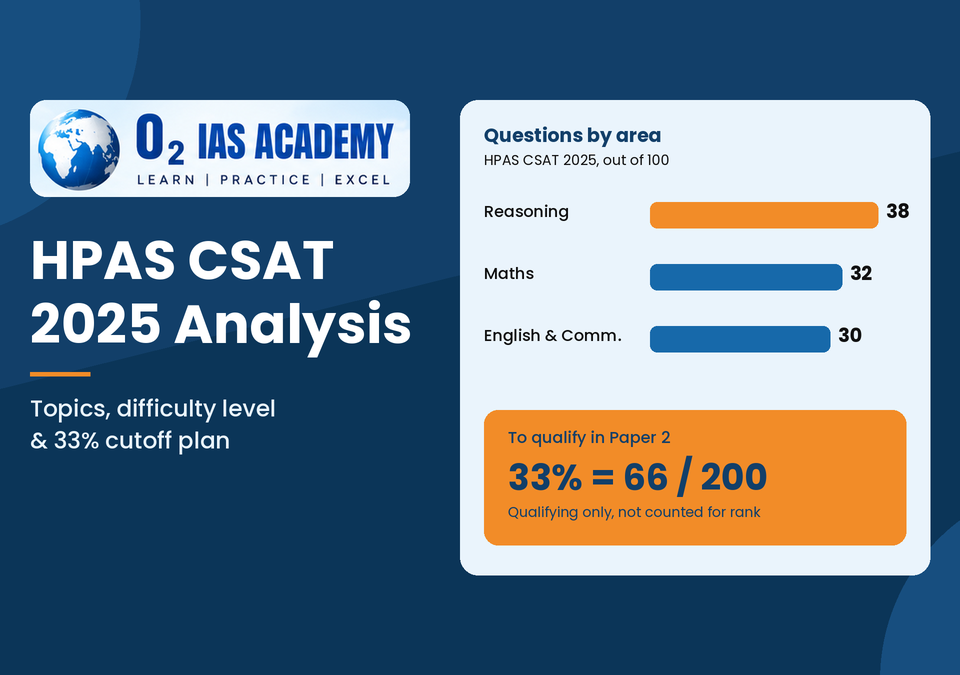
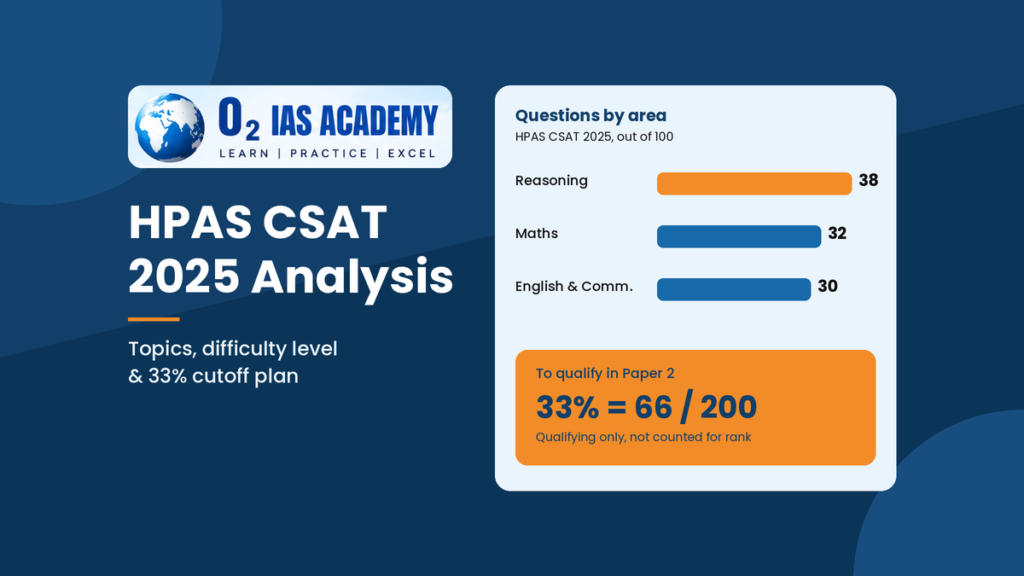
Preparing for CSAT too? Read our HPAS CSAT 2025 analysis.
A note on the numbers: They come from a manual count of each paper, and the yearly totals in the count do not add up to exactly 100. Treat every figure as a close estimate, not an exact tally. The 2022 paper was not part of this count. Verify the figures against the original papers on the official HPPSC website before planning around them.
HPAS Prelims GS Analysis at a Glance
- Biggest subject: Himachal Pradesh GK, averaging about 24 questions, though it has fallen from 31 in 2020 to 20 in 2024 and 2025.
- Steady subjects: Polity (9 to 13 a year) and Geography (10 to 14 a year).
- Rising: Modern India, from 5 to 8 questions a year to 15 in 2024 and 13 in 2025.
- Fading: Ancient and Medieval India, with no questions in 2024 or 2025, and Current Affairs, down from 13 in 2020.
- Common formats: statement-based, chronological order, match-the-list and north-to-south ordering.
HPAS Prelims GS Paper Pattern
| GS Paper I | CSAT Paper II | |
|---|---|---|
| Questions | 100 | 100 |
| Marks | 200 | 200 |
| Time | 2 hours | 2 hours |
| Purpose | Decides your rank | Qualifying only (33%) |
Each question is worth 2 marks, and wrong answers carry one-third negative marking. Check the latest notification to confirm this before you finalise your plan.
HPAS Prelims Subject-Wise Weightage 2020–2025
The table shows the estimated number of GS Paper I questions per subject in each paper. The 2022 paper is not included.
| Subject | 2020 | 2021 | 2023 | 2024 | 2025 | Average |
|---|---|---|---|---|---|---|
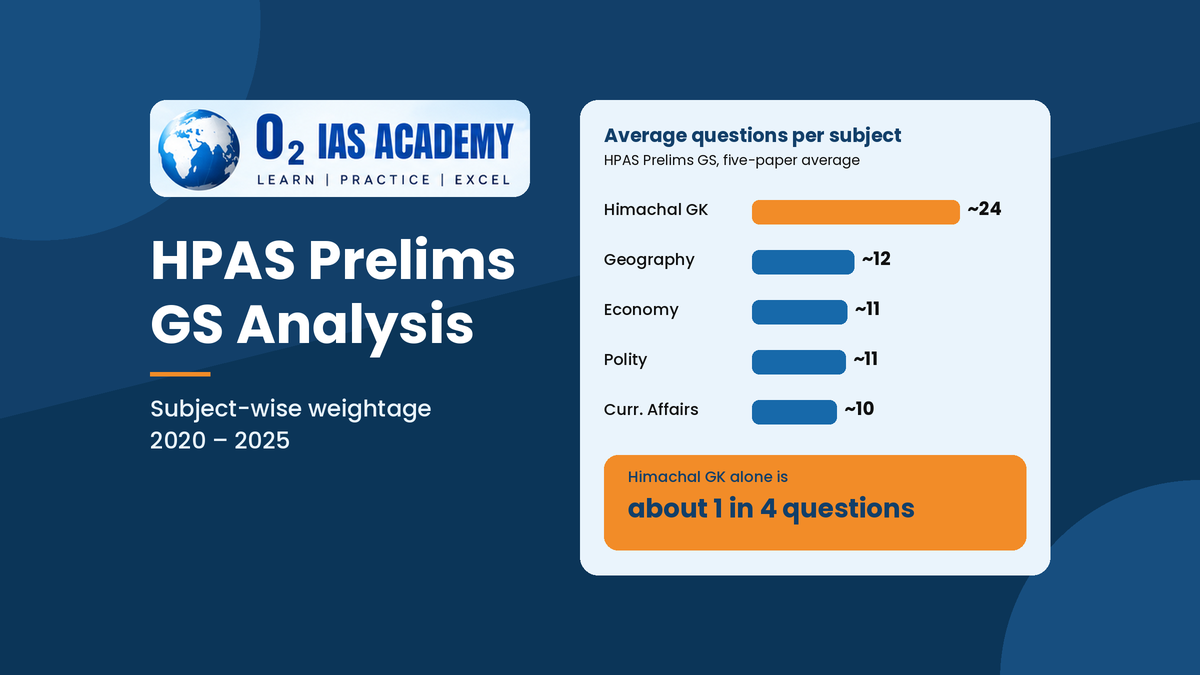
| Himachal Pradesh GK | 31 | 24 | 23 | 20 | 20 | ~24 |
| Geography | 11 | 10 | 12 | 14 | 11 | ~12 |
| Economy | 7 | 12 | 10 | 15 | 10 | ~11 |
| Indian Polity | 9 | 13 | 10 | 11 | 10 | ~11 |
| Current Affairs | 13 | 12 | 6 | 9 | 8 | ~10 |
| Modern India (History) | 8 | 6 | 5 | 15 | 13 | ~9 |
| Environment | 3 | 12 | 11 | 7 | 10 | ~9 |
| Science | 4 | 10 | 5 | 9 | 5 | ~7 |
| Ancient and Medieval India | 2 | 5 | 6 | 0 | 0 | ~3 |
| Technology | 1 | 1 | 2 | 4 | 3 | ~2 |
| Art and Culture | 1 | 0 | 0 | 0 | 0 | <1 |
| Total counted | 90 | 105 | 90 | 104 | 90 | ~96 |
The totals row shows why every figure is an estimate. Each paper has 100 questions, but the manual count came to between 90 and 105, because some questions fit more than one subject and some were not counted. Use the averages to compare subjects, not to predict an exact count.
Six HPAS Prelims GS Trends Worth Knowing
- Himachal GK is the biggest block, but it is shrinking. It was 31 questions in 2020 and has settled at 20 in the last two years. It is still the single largest subject, roughly one question in five today and about one in four on the five-year average, so it remains your top priority. Just do not expect 30 questions again.
- Modern India jumped in 2024 and 2025. After 5 to 8 questions a year, it went to 15 in 2024 and 13 in 2025. Social reform movements, groups that existed before the Congress, and events from 1857 to 1947 were the main areas.
- Ancient and Medieval India have disappeared for now. Neither had a single question in 2024 or 2025. Do not drop them completely, but give them the least time.
- Polity and Geography are steady. Polity stayed between 9 and 13 questions every year, and Geography between 10 and 14. These two are dependable marks.
- Economy and Environment move up and down. Economy ranged from 7 to 15, and Environment from 3 to 12. You cannot guess a year in advance, so prepare both fully.
- Current Affairs has come down. It was 13 in 2020 and 12 in 2021, and has been between 6 and 9 since 2023. It still matters, but it no longer needs half your day.
HPAS Prelims GS Subject-Wise Trend Analysis and Question Pattern
Here is what the 2020, 2021, 2023, 2024 and 2025 papers asked in each subject, in order of priority, with example questions from past papers.
Himachal Pradesh GK Questions in HPAS Prelims
- History and geography: hill state origins and founders, Praja Mandal movements, regional uprisings (Pajauta, Mandi Conspiracy, Dandra, Dodra-Kwar), Dhami shooting, merger and statehood milestones, glaciers, rivers and lakes.
- Economy and culture: HP Economic Survey figures (GSDP share of agriculture and industry, per capita income), state schemes, tribal groups (Gaddis, Swanglas, Kinnauras) and local customs.
Example questions:
- Mian Jawahar Singh, Sh. Badri Nath and Sh. Jwala Singh were the leaders of which of the following revolutionary movements of H.P.?(A) Praja Mandal (B) Gadar Party (C) Pajauta Movement (D) Dumh Movement
- Who prepared the "Report of the Land Revenue settlement of the Kangra District, printed in 1874"?(A) J.B. Lyall (B) G.C. Barnes (C) J.D. Cunningham (D) Victor Jacquino
Indian Polity Questions in HPAS Prelims
- Core topics: constitutional amendments (73rd, 74th, 86th, 103rd, 104th), Articles on fundamental rights and reservations (15, 16, 243, 312, 330, 340, 342), writs (Habeas Corpus, Mandamus, Certiorari), parliamentary procedures (Cut Motion, Adjournment Motion, Zero Hour, Money Bill) and commissions (NCW, NHRC, NCPCR, NITI Aayog).
- Question type: a heavy mix of statement-based options, direct Article matching and conceptual questions.
Example questions:
- Who decides the matter of disqualification of MLA for matters other than those given in the Tenth Schedule of the Constitution?(A) Speaker Legislative Assembly (B) High Court (C) Governor (D) State Election Commission
- Through 73rd Constitutional Amendment Act 1/3 seats for the women are reserved in the Panchayats under which Article?(A) Article 243-A (B) Article 243-B (C) Article 243-C (D) Article 243-D
Geography Questions in HPAS Prelims (Indian and World)
- Physiography and rivers: river origins and tributaries (Jhelum, Kosi, Sutlej, Narmada, Godavari, Mahanadi), mountain ranges and passes (Karakoram, Zojila, Niti, Rohtang, Khunjerab) and landforms such as the Bist, Chaj and Bari doabs.
- World geography: capital cities, landlocked countries (Bolivia), seas and straits (Malacca, Bab el-Mandeb), the Alps, tribes (Bedouins, Kirghiz, Flemish) and industrial towns (Lyons, Abadan, Sheffield).
Example questions:
- Which of the following glaciers is located in the Karakoram ranges of Himalayan region?(A) Shafat (B) Milam (C) Zemu (D) Biafo
- Arrange the following deserts of the world from smallest to largest in terms of area: (1) Gobi (2) Thar (3) Kalahari (4) Taklimakan.(A) (1), (2), (3), (4) (B) (4), (3), (2), (1) (C) (2), (4), (3), (1) (D) (1), (3), (2), (4)
Economy Questions in HPAS Prelims
- Basic concepts: inflation, poverty lines and headcount ratios (Multidimensional Poverty Index, Tendulkar, Lakdawala and Rangarajan committees), types of unemployment, fiscal deficit, revenue deficit and FRBM limits.
- Banking and policy: RBI monetary tools (repo rate, CRR, Operation Twist), financial inclusion and growth models.
- Government schemes: PM-KISAN, Startup India, Make in India, PM Gati Shakti, PMJDY and Ayushman Bharat.
Example questions:
- According to FRBM Act, India's fiscal deficit should not exceed:(A) 2 percent of GDP (B) 3 percent of GDP (C) 4 percent of GDP (D) 3.5 percent of GDP
- Which of the following best explains "Operation Twist" by RBI?(A) It increases CRR while decreasing SLR (B) It simultaneously buys long-term and sells short-term government securities (C) It raises repo rate but reduces reverse repo (D) It involves swapping forex reserves for rupee bonds
Indian History and Culture Questions in HPAS Prelims
- Modern India: pre-Congress organisations (British Indian Association, Poona Sarvajanik Sabha, India League), socio-religious reform movements (Young Bengal Movement, Prarthana Samaj, Veda Samaj, Satyashodhak Samaj), Governor-Generals and Viceroys, and freedom struggle events (Quit India, INA Trials, Non-Cooperation).
- Ancient and Medieval: dynasty founders, literature and authors (Tarikh-i-Rashidi, Jivaka Chintamani, Bhasa's plays), battles (Dohariya, Bilgram, Machhiwara, Talikota) and foreign travellers (Pietro Della Valle, Niccolao Manucci).
Example questions:
- Who was the author of the book "Gulamgiri"?(A) Swami Dayanand (B) Dr. B. R. Ambedkar (C) Mahatma Jyotiba Phule (D) Swami Ramkrishan Parmhans
- Arrange these Pre-Congress Associations in chronological order: (1) Indian Association (2) Bombay Presidency Association (3) British Indian Association (4) Poona Sarvajanik Sabha.(A) (1), (3), (4), (2) (B) (3), (1), (2), (4) (C) (3), (4), (1), (2) (D) (3), (4), (2), (1)
Environment and Ecology Questions in HPAS Prelims
- Protected areas: national parks, tiger reserves, biosphere reserves and Ramsar wetlands (Deepor Beel, Asthamudi, Loktak, Rudrasagar).
- Conventions and Acts: Water Act, Air Act, Wildlife Protection Act, Forest Policy, and the timelines of CITES, UNCCD and CBD.
- Concepts: trophic levels, energy flow, food chains, air and water pollution (smog precursors, eutrophication) and desertification.
Example questions:
- Arrange the following conventions in chronological order: (1) Convention to combat desertification (2) Convention on biological diversity (3) Convention on trade in endangered species (4) Convention on wetlands.(A) (4), (3), (1), (2) (B) (1), (2), (3), (4) (C) (4), (3), (2), (1) (D) (4), (2), (3), (1)
- Who gave the concept of biodiversity hotspots?(A) E. P. Odum (B) Norman Myers (C) James Lovelock (D) Rachel Carson
Current Affairs Questions in HPAS Prelims
- National and international events: international summits (G20, G7, ASEAN, COP), indices (Global Innovation Index, EIU Democracy Index), awards and bilateral relations.
Example questions:
- Which position India got in the Global Innovation Index 2024?(A) 35th (B) 39th (C) 55th (D) 25th
- Who is appointed as the new Prime Minister of Italy in February 2021?(A) Mario Draghi (B) Giancarlo Giorgetti (C) Andrea Orlando (D) Luigi Di Maio
Science and Technology Questions in HPAS Prelims
- Biology: human physiology (kidney stones, blood pressure, digestive system and enzymes), diseases, nutrition, plant biology and cell organelles.
- Physics and chemistry: optics (concave and convex mirrors, reflection and refraction), SI units (power of lens, electric potential, pressure), speed of sound in gases and common compounds (slaked lime, lactic, oxalic and tartaric acids).
- Technology: space missions (Aditya-L1, XPoSat, Cartosat, Tianwen-1), defence exercises (Surya Kiran, Garuda Shakti, SIMBEX) and digital platforms.
Example questions:
- Fats are made from edible oils using the process of:(A) Saponification (B) Esterification (C) Catalytic hydrogenation (D) Hydrogenation
- Arrange the following elements in terms of their atomic number from lowest to highest: (1) Carbon (2) Oxygen (3) Sodium (4) Silicon.(A) (4), (3), (2), (1) (B) (3), (4), (1), (2) (C) (2), (4), (1), (3) (D) (1), (2), (3), (4)
Question Formats to Practise for HPAS Prelims
The commission leans on a few formats, so practise them rather than only reading:
- Statement-based questions: several statements, and you pick the correct combination.
- Chronological order: arrange events, associations or conventions by date.
- North-to-south or small-to-large ordering: common in geography and environment.
- Match the list: match items in List I with List II.
- Direct fact questions: an article number, an author, a location.
How to Split Your Study Time for HPAS Prelims GS
Use the five-year averages as a guide:
| Priority | Subjects | Share of questions |
|---|---|---|
| 1 | Himachal GK | about one in four |
| 2 | Polity, Geography, Economy | about one in three, combined |
| 3 | Modern History, Environment, Current Affairs | about 28% combined |
| 4 | Science, Technology | about 9% combined |
| 5 | Ancient and Medieval, Art and Culture | under 4% combined |
Give the most hours to Himachal GK, then Polity, Geography and Economy. Put modern history, environment and current affairs next, and fit science and technology around them. Treat ancient, medieval and art as a short revision at the end.
How to Prepare for HPAS Prelims: Preparation Strategy
Master Himachal Pradesh GK (20–30% weightage)
- Resource: HP General Knowledge (Himpedia Himachal GK book), alongside the latest HP Economic Survey and State Budget.
- Focus: HP administrative history, princely state founders, anti-British uprisings, Praja Mandals, geography (passes, glaciers, tributaries) and survey figures.
Core static subjects: Polity, Modern History, Geography
- Polity: read M. Laxmikanth thoroughly. Prioritise Part III (Fundamental Rights), Part IV (DPSPs), amendments, constitutional bodies, parliamentary motions and Panchayati Raj (73rd and 74th Amendments).
- Modern History: use Spectrum's A Brief History of Modern India. Emphasise socio-religious reform organisations, pre-1885 political bodies, major events from 1857 to 1947 and British legislative acts.
- Geography: rely on Class 11 and 12 NCERTs. Practise map-based locations: rivers, passes, mountain ranges from north to south and east to west, world straits and industrial regions.
Targeted approach for Science, Economy and Environment
- Science: cover Class 9 and 10 Science NCERTs. Concentrate on direct facts: optical instruments, SI units, basic human body processes, acids and bases, and chemical compounds.
- Economy: focus on basic definitions (types of inflation, deficits, unemployment), committee recommendations on poverty and RBI monetary policy tools.
- Environment: learn national parks, tiger reserves, biosphere reserves, Ramsar sites and key environmental Acts and chronologies.
Current Affairs and Technology
- Review monthly current affairs compilations covering national and international summits, global indices and rankings (for example the Global Innovation Index and SDG Index), awards, and ISRO and defence technology updates.
Practise pattern-specific MCQs
- Practise multi-statement questions, "Match List-I with List-II" and chronological ordering. HPPSC favours these formats to test depth of knowledge.
Mistakes to Avoid in HPAS Prelims Preparation
- Studying all subjects equally, when Himachal GK alone is a fifth of the paper.
- Dropping Ancient and Medieval India completely because it was absent for two years.
- Reading only, with no practice on ordering and statement questions.
- Collecting too many books instead of finishing a few.
- Revising current affairs daily but ignoring the Economic Survey.
- Treating CSAT as optional, when failing it means your GS paper is not checked.
Practise with HPAS Previous Year Papers and Test Series
HPAS Previous Year Question Papers
Download the 2020 to 2025 GS papers, tally the questions by subject yourself and compare with this post. Then solve them under timed conditions.
Explore HPAS PYQsHPAS Prelims Test Series
After covering the high-priority subjects, a test series helps you practise statement-based, ordering and match-the-list questions under exam conditions and find your weak areas.
Explore HPAS Test SeriesNeed Guidance for HPAS Prelims Preparation?
Not sure how to split your hours across subjects or use past papers? Talk to the O2 IAS Academy team about your preparation and next steps.
HPAS Prelims GS Paper: Frequently Asked Questions
Which subject has the most questions in HPAS Prelims GS?
Himachal Pradesh GK. It has been the largest block every year, with 20 questions in 2024 and 2025.
Has the weightage of Himachal GK changed?
Yes. It was about 31 questions in 2020 and has been about 20 in the last two years. It is still the biggest subject.
Which subjects are asked the most after Himachal GK?
Geography, Economy and Polity each average roughly 10 to 12 questions a year.
Is Modern History important for HPAS Prelims?
Yes. It carried 15 questions in 2024 and 13 in 2025, up from 5 to 8 earlier.
Are Ancient and Medieval History still asked?
Not recently. Neither had a question in 2024 or 2025, so give them the least time.
What types of questions does HPPSC ask?
Statement-based questions, chronological ordering, north-to-south ordering, match-the-list and direct fact questions.
How should I prepare current affairs for HPAS Prelims?
Use monthly compilations. Focus on summits, rankings, awards, bilateral ties and space and defence news.
Is there negative marking in HPAS Prelims?
Yes, one-third of the marks per wrong answer. Check the latest notification.
Do these numbers match the official count exactly?
No. They come from a manual count, and the yearly totals do not add up to exactly 100. Use them as a guide and verify against the papers yourself.
Key Takeaways from the HPAS Prelims GS Analysis
Five years of papers give a clear picture. Himachal GK is the largest block and should be your first priority. Polity, Geography and Economy come next because they are steady. Modern History has become more important, while Ancient and Medieval History have faded for now.
Your next step is simple:
- Download the 2020 to 2025 GS papers.
- Tally the questions by subject yourself and compare with this post.
- Spend your hours in the order of that tally.
And keep CSAT in your plan. Read our HPAS CSAT 2025 analysis to see how to clear it without losing your GS effort.