European Travellers in Himachal Pradesh: History & HPAS Notes
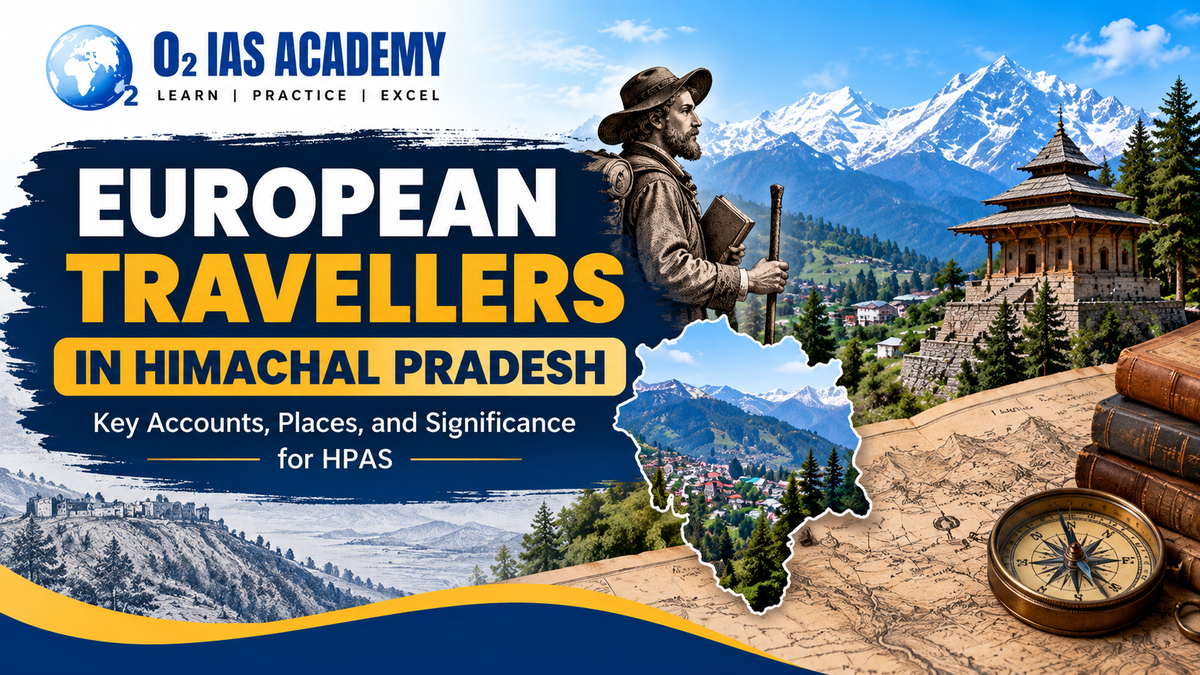
European Travellers in Himachal Pradesh: Important History Notes for HPAS
From Thomas Coryate's account of Kangra to William Moorcroft's journey through Rohtang Pass and A.P.F. Harcourt's records of Kullu, Lahaul and Spiti, European travellers left valuable accounts of the Western Himalayas. Explore their journeys, travelogues and historical significance in this chronological guide.
Talk to a Teacher Quick Revision TableThe history of Himachal Pradesh is closely connected with its hill principalities, mountain passes, pilgrimage centres and changing political relationships. Before modern roads and railways connected the region, travellers moved through difficult mountain routes, often relying on local guides, porters and pack animals.
Their journals, maps, sketches and published travel accounts provide insights into the geography, trade, religious life and administration of the hill states. These accounts span the Mughal period, the expansion of Sikh power under Maharaja Ranjit Singh and the growth of British influence during the nineteenth century.
For HPAS and other Himachal Pradesh competitive examinations, this topic is useful for connecting historical personalities with the places they visited, their publications and the events associated with their journeys.
1. William Finch and Thomas Coryate: Early European Accounts of Kangra
During the reign of Mughal Emperor Jahangir, English travellers William Finch and Thomas Coryate left some of the early recorded European impressions associated with the Kangra region.
William Finch (1608–1610)
William Finch provided early geographical descriptions of routes leading towards the Kangra hills. His journey belongs to the early phase of European travel accounts connected with northern India.
Thomas Coryate (1615–1617)
Thomas Coryate was known as the “English Fakir” because of his extensive travels on foot across Europe and Asia. He reached Kangra town and recorded observations about the sacred Bajreshwari Devi temple and its significance for pilgrims.
His accounts were later associated with Purchas His Pilgrimes, a major collection of travel narratives.
2. George Forster: The Traveller in Disguise
George Forster, a civil servant of the East India Company, undertook an overland journey from Bengal to England in 1783. His route passed through several hill regions, including Nahan, Bilaspur, Haripur and Nurpur.
According to the supplied historical account, Forster travelled disguised as a Turkish or Muslim merchant while crossing areas where unfamiliar travellers could face suspicion and insecurity.
His two-volume work, A Journey from Bengal to England, describes aspects of local administration, border duties known as rahdari, court politics and the position of hill chieftaincies during the late eighteenth century.
3. James Baillie Fraser: The Post-Anglo-Gorkha War Landscape
The Anglo-Gorkha War of 1814–1815 changed the political situation across the Shimla hill states. In the period immediately following the conflict, James Baillie Fraser travelled through the hill states and valleys associated with the Giri, Sutlej and Yamuna rivers.
Accompanied by his brother William Fraser, James Baillie Fraser documented the landscape, mountain terrain and fort architecture. He was particularly known for his landscape art and watercolour work.
His publication, Journal of a Tour through part of the Snowy Range of the Himala Mountains, provides a record of the region during an important period of political transition and growing British influence.
For wider historical context, the official history of Shimla town describes the Anglo-Gorkha conflict and the subsequent changes in the hill states.
4. William Moorcroft: Rohtang Pass, Trade Routes and Lahaul
William Moorcroft was a veterinary surgeon who served as Superintendent of the East India Company's military horse stud. His search for suitable horse-breeding stock took him through Mandi, Kullu and Lahaul as he explored routes towards Central Asia.
His observations were published in Travels in the Himalayan Provinces of Hindustan and the Panjab. The work covered much more than horses and breeding practices.
Important observations
- Rohtang Pass: The supplied document identifies Moorcroft as the first Englishman to reach and document the pass, which he referred to as Ritanka Jot.
- Trade: He recorded salt-trading routes connecting Mandi and Kullu with Ladakh.
- Local life: His accounts described agriculture, diet and social customs in Lahaul.
- Regions visited: Mandi, Kullu and Lahaul.
5. Captain Mundy and Major Archer: Early Development of Shimla
In 1829, Captain Godfrey Charles Mundy and Major Edward C. Archer travelled to Shimla with Lord Combermere, the British Commander-in-Chief.
The visit coincided with early infrastructure developments in Shimla, including a suspension bridge and a substantial water reservoir associated with Lord Combermere's initiatives.
Captain Mundy documented the journey in Pen and Pencil Sketches, combining observations with sketches. Major Archer's account appeared in Tours in Upper India.
Their records help illustrate Shimla's early transformation into a colonial hill station. The Himachal Tourism official page on Shimla provides additional context about the town's colonial heritage.
6. Baron Charles Hügel: Natural History under the Sikh Empire
Baron Charles Hügel was an Austrian nobleman, botanist and explorer who travelled through Bilaspur, Mandi, Kangra and Jwalamukhi in the mid-1830s.
During this period, many hill regions were connected politically to the expanding influence of Maharaja Ranjit Singh's Lahore Durbar. Hügel's travel account, Travels in Kashmir and the Panjab, documented both the natural environment and the political conditions he encountered.
What did Hügel record?
- Regional flora, alpine botany and horticulture.
- The natural flames associated with the Jwalamukhi pilgrimage shrine.
- The influence of the Sikh Empire and tributary relationships with local hill rulers.
7. Godfrey Thomas Vigne: Kangra, Bilaspur and Chamba
Godfrey Thomas Vigne was an explorer, artist and accomplished amateur cricketer who played first-class cricket for Hampshire and the Marylebone Cricket Club (MCC).
Between 1835 and 1839, Vigne travelled across parts of the Western Himalayas, including Kangra, Bilaspur and Chamba. In 1839, he was received at the court of Raja Charhat Singh of Chamba.
His travel memoir, Travels in Kashmir, Ladak, Iskardo..., records observations about mountain river systems, regional geography and the political atmosphere of the hill courts before the Anglo-Sikh Wars.
8. John Colam Davidson: Mountain Routes and Hill Administration
John Colam Davidson explored the rugged mountain tracks of the Shimla hill states in 1843–1844. His work, Diary of Travels and Adventures in Upper India, offers observations about the practical challenges of travel through remote mountain areas.
His account focused on the availability of porters, trail conditions, pack-animal management and the functioning of local hill administration. It also described the roles of hill chiefs, including ranas and thakurs, in matters of justice and taxation.
9. Dr. J.G. Gerard and Lord Elgin: The Rohtang Pass Journey
In 1863, Lord Elgin (James Bruce, 8th Earl of Elgin), then Viceroy and Governor-General of India, travelled in the Kullu and Lahaul region accompanied by Dr. J.G. Gerard, a medical officer and Himalayan explorer.
The reported Rohtang Pass crossing
The supplied document records that the party crossed Rohtang Pass twice in a single day, travelling between Kullu and Lahaul. It gives the pass's elevation as 13,058 feet.
The account also records that Lord Elgin fell seriously ill and died in Dharamshala on 20 November 1863. He was buried at the cemetery of St. John in the Wilderness Church near Dharamshala.
This episode connects Himalayan exploration with an important event in the history of British India. For historical context about the wider region, consult the official Himachal Pradesh Government website.
10. Captain A.P.F. Harcourt: The Chronicler of Kullu, Lahaul and Spiti
Captain A.P.F. Harcourt served as the British Assistant Commissioner for Kullu, with administrative responsibilities extending to Lahaul and Spiti. Unlike travellers whose observations were based on shorter journeys, Harcourt's official position gave him sustained exposure to the region.
He authored The Himalayan Districts of Kooloo, Lahoul, and Spiti (1871), an important historical and geographical account of the area.
Key subjects covered by Harcourt
- Traditional temple architecture and woodcarving in Kullu.
- The local devta system and associated cultural practices.
- Social customs and land-tenure practices.
- Monasteries in Lahaul and Spiti.
- Mountain trails, high passes and regional trade networks.
Quick Revision Table: European Travellers in Himachal Pradesh
Use this table for a quick last-minute revision of the travellers, their periods, the regions they visited and their principal historical associations.
| Period | Traveller(s) | Region / Association | Important Work or Fact |
|---|---|---|---|
| 1608–1610 | William Finch | Routes towards Kangra | Early geographical descriptions |
| 1615–1617 | Thomas Coryate | Kangra town | “English Fakir”; Bajreshwari Devi temple |
| 1783 | George Forster | Nahan, Bilaspur, Haripur, Nurpur | A Journey from Bengal to England |
| 1815 | James Baillie Fraser | Shimla hill states, Sutlej and Yamuna valleys | Landscape art and post-war hill records |
| 1820–1822 | William Moorcroft | Mandi, Kullu, Lahaul | Rohtang Pass (Ritanka Jot), trade routes |
| 1829 | Captain Mundy and Major Archer | Shimla | Pen and Pencil Sketches; Tours in Upper India |
| 1835–1836 | Baron Charles Hügel | Bilaspur, Mandi, Kangra, Jwalamukhi | Travels in Kashmir and the Panjab |
| 1835–1839 | Godfrey Thomas Vigne | Kangra, Bilaspur, Chamba | Visited the court of Raja Charhat Singh in 1839 |
| 1843–1844 | John Colam Davidson | Shimla hill tracks | Diary of Travels and Adventures in Upper India |
| 1863 | Dr. J.G. Gerard and Lord Elgin | Rohtang Pass, Lahaul, Dharamshala | Rohtang journey; Lord Elgin died at Dharamshala |
| 1869–1871 | Captain A.P.F. Harcourt | Kullu, Lahaul, Spiti | The Himalayan Districts of Kooloo, Lahoul, and Spiti (1871) |
Related HPAS Preparation Resources
Continue your preparation with these related O2 IAS Academy resources:
HPAS Notification 2026
Refer to the HPAS notification resource for examination-related information and recruitment updates.
HPPSC HPAS Syllabus 2026
Review the syllabus and organise your preparation around the relevant examination subjects and topics.
Further Reading and Official References
For additional context on Himachal Pradesh's regional history and the development of Shimla, refer to these official sources:
- History of Shimla Town — District Administration, Shimla
- Government of Himachal Pradesh — Official Portal
- Shimla — Himachal Tourism Official Website
- Heritage of Himachal Pradesh — Himachal Tourism
The historical summaries in this article are based on the supplied reference document. The official links provide supplementary context; they should not be treated as independent verification of every individual traveller detail.
Need Guidance for Your HPAS Preparation?
Not sure how to organise Himachal Pradesh GK, revise history topics or connect your preparation with the HPAS syllabus? Talk to a teacher to discuss your preparation and clarify your doubts.
Frequently Asked Questions
Who was known as the “English Fakir” in Himachal history?
Thomas Coryate was known as the “English Fakir”. His travels included Kangra, where he recorded observations associated with the Bajreshwari Devi temple.
Which European traveller is associated with Rohtang Pass (Ritanka Jot)?
William Moorcroft is associated with reaching and documenting Rohtang Pass, referred to in his journals as Ritanka Jot.
Who wrote The Himalayan Districts of Kooloo, Lahoul, and Spiti?
Captain A.P.F. Harcourt authored The Himalayan Districts of Kooloo, Lahoul, and Spiti, published in 1871.
Which travellers documented the early development of Shimla in 1829?
Captain Godfrey Charles Mundy and Major Edward C. Archer visited Shimla with Lord Combermere in 1829 and recorded aspects of the town's early development.
Which European traveller visited Jwalamukhi and recorded regional flora?
Baron Charles Hügel, an Austrian naturalist and botanist, travelled through Bilaspur, Mandi, Kangra and Jwalamukhi in 1835–1836.
Which travellers are associated with the Rohtang Pass journey of 1863?
Dr. J.G. Gerard and Lord Elgin are associated with the 1863 journey through the Rohtang Pass and Lahaul region.
How should I prepare this topic for HPAS?
Prepare a chronological timeline and revise each traveller's name, period, places visited, published work and distinctive contribution. Then practise recalling the associations without looking at the revision table.