Difference between JKPSC vs UPSC preparation
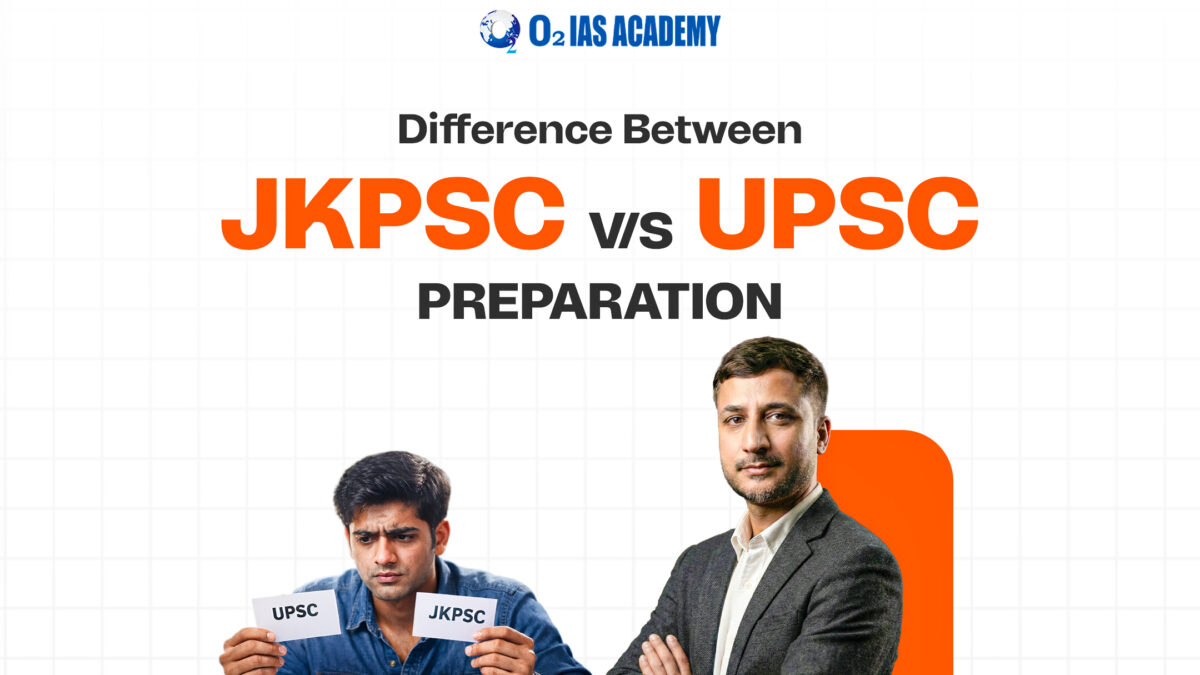
UPSC vs JKPSC: What Really Differs in Preparation?
The Complete Truth About Preparing for Both Civil Service Examinations
Both JKPSC KAS (Jammu and Kashmir Administrative Service) and UPSC CSE (Civil Services Examination) are prestigious civil service examinations that open doors to administrative careers. JKPSC is conducted at the Union Territory level for Jammu and Kashmir, while UPSC is the national-level examination.
On paper, these two exams look remarkably similar. Both follow a three-stage examination process — Prelims, Mains, and Interview. Merit is compiled by adding the marks obtained in Mains and Interview stages. The pattern and distribution of marks show significant overlap, and the syllabus covers many common subjects like History, Geography, Polity, Economy, and Current Affairs.
The similarity is visible. The difference is strategic.
Most aspirants assume that preparing for UPSC automatically prepares them for JKPSC KAS. This assumption has cost many students their attempts.
The Dangerous Assumption Most Students Make
Because of the visible similarities between UPSC CSE and JKPSC KAS, most students believe that preparing for UPSC will automatically make them prepared for JKPSC KAS as well. This belief has been around for years, and yes, some students have managed to balance both.
But here is the hard truth: most students who follow this approach struggle. They walk into JKPSC with confidence built from their UPSC preparation, only to realize during or after the exam that something was fundamentally different.
Mindset Trap: "If I'm preparing for UPSC, qualifying JKPSC KAS will be easy."
This mindset leads to inadequate preparation for JKPSC-specific aspects. Students ignore regional content, underestimate factual preparation, and fail to adjust their answer-writing approach. Eventually, this results in disappointment.
The alignment of syllabus was meant to help students get dual opportunities — not to make one exam a backup for the other. Overlooking the subtle but critical differences between the two examinations is where the real problem begins.
Understanding these differences is not optional — it is essential.
So What Really Makes JKPSC and UPSC Different?
In spite of having similar syllabus, overlapping books, and comparable exam stages, JKPSC KAS and UPSC CSE are not identical examinations. The difference lies not in what is written on paper, but in how the exams are designed, conducted, and evaluated.
There are five critical differences that can make or break your performance. Understanding them clearly is essential if you are serious about preparing for both.
These differences are not small technical variations. They directly impact your study strategy, answer-writing style, time allocation, and exam-day performance.
Difference #1: The Exam Conducting Authority and Their Mindset
The first and most fundamental distinction lies in the mindset of the conducting authority. JKPSC is a Union Territory-level examination with a long-established pattern and approach. Over decades, its system has developed certain fixed tendencies in question framing and evaluation.
- Question framing often follows historical patterns.
- Evaluation methodology tends to remain relatively consistent.
- Focus areas do not shift drastically year after year.
- Less experimentation in question format.
In contrast, UPSC operates at the national level and follows a very different philosophy. It constantly evolves, experiments, and redesigns its question style to test candidates in deeper and more comprehensive ways.
- Regular change in question style and difficulty level.
- Unexpected angles from current affairs.
- Greater emphasis on application rather than recall.
- Testing administrative thinking, not just knowledge.
What This Means for You:
For JKPSC, preparation may sometimes feel unpredictable — papers can vary between factual repetition and random current-based questions. Pattern prediction becomes difficult.
For UPSC, even if you master past year trends, you must prepare comprehensively because surprise elements are common.
Realistically speaking, studying administrative structure for JKPSC may require thorough factual coverage. But in UPSC, the same topic might be asked in a way that demands application to a contemporary governance challenge.
Difference #2: State Specificity – The Game Changer
This is where JKPSC KAS truly separates itself from UPSC CSE. The JKPSC examination includes substantial questions on Union Territory-specific socio-economic, historical, and governance aspects of Jammu & Kashmir. This is not a minor addition — it is a fundamental component that can determine your success or failure.
Understanding this distinction directly impacts how you allocate your time, what sources you choose, and how you design your preparation strategy.
What J&K-Specific Content Actually Includes
- History & Cultural Heritage: Ancient Kashmir, Dogra rule, accession to India, Article 370, reorganization into UT, regional languages and traditions.
- Geography of J&K: Rivers like Jhelum and Chenab, Pir Panjal and Karakoram ranges, valleys, glaciers, climate zones, districts and divisions.
- Economy: Saffron cultivation, apple orchards, handicrafts, tourism, hydroelectric projects, unemployment and infrastructure challenges.
- Governance & Administration: UT structure post-2019, role of Lieutenant Governor, district administration, Panchayati Raj institutions.
- Regional Current Affairs: Infrastructure projects, policy decisions, welfare schemes, political developments.
Reality Check: How much of this is covered in your UPSC preparation? Almost none. Your UPSC books do not cover the tributaries of Ravi in detail, the administrative structure of J&K post-reorganization, or the economic impact of saffron cultivation.
This is why dedicated J&K-specific preparation is non-negotiable. Without it, you may be missing nearly 30–40% of the actual JKPSC exam content.
Difference #3: The Nature of Questions – Factual vs Analytical
This is the difference that catches most students off-guard. JKPSC and UPSC may share syllabus topics, but the way questions are framed is fundamentally different.
The core distinction is simple: JKPSC KAS tends to ask more factual and direct questions, whereas UPSC CSE focuses heavily on analysis, interpretation, and multi-dimensional thinking.
How UPSC Frames Questions (Analysis-Based)
- Analyze causes and long-term effects
- Compare and contrast viewpoints
- Evaluate policies critically
- Suggest improvements or reforms
- Connect economic, social, political and environmental dimensions
Example: “Critically examine the impact of digital economy on India's informal sector.” This demands analysis, examples, and balanced evaluation — not just definition.
How JKPSC Frames Questions (Factual & Direct)
- More emphasis on factual recall
- Questions may be direct and descriptive
- Coverage of specific regional topics
- Sometimes disproportionate focus on certain syllabus areas
In some cases, JKPSC questions may not align proportionally with the syllabus. For example, International Relations may receive more coverage in a GS paper compared to UPSC, which generally maintains proportional balance.
What This Means for Your Preparation:
For UPSC, focus on analytical depth, structured arguments, and application of knowledge.
For JKPSC, ensure strong factual clarity, detailed coverage, and descriptive presentation.
Difference #4: The Process of Awarding Marks in Mains
This difference directly impacts how you should write your answers. JKPSC and UPSC follow different evaluation philosophies in their Mains examination. What scores well in one may not fetch similar marks in the other.
UPSC Mains Evaluation Style
- Strong emphasis on analytical depth
- Balanced presentation of multiple viewpoints
- Clear Introduction–Body–Conclusion structure
- Use of case studies, examples, and contemporary relevance
- Ability to connect economic, social, political and ethical dimensions
In UPSC, average answers may score 5–6/10. Strong analytical and well-structured answers may fetch 7–8. Excellence demands clarity, balance, and depth.
JKPSC Mains Evaluation Style
- Comprehensive factual coverage
- Accuracy and clarity of information
- Organized presentation with headings
- Inclusion of J&K-specific context where relevant
- Descriptive and thorough writing style
Marking can vary depending on examiner and year. Structured presentation and factual completeness become very important.
What This Means for Your Answer Writing Strategy
For UPSC: Focus on analysis, structured arguments, diagrams, and multidimensional thinking.
For JKPSC: Focus on detailed factual coverage, clear headings, J&K examples, and descriptive clarity.
Difference #5: The Timing Nightmare – The Most Challenging Difference
This is perhaps the most stressful difference between JKPSC and UPSC. It is not about syllabus. It is not about marking. It is about timing.
UPSC follows a predictable annual calendar. JKPSC does not. This mismatch creates serious strategic dilemmas for students preparing for both exams simultaneously.
How UPSC Schedule Works (Predictable)
- Notification usually around February
- Prelims in May/June
- Mains in September/October
- Final results by April–May next year
This predictability allows students to plan revision cycles, test series, and preparation stages systematically.
How JKPSC Schedule Works (Unpredictable)
- No fixed annual calendar
- Notification may come anytime
- Exam dates may be delayed
- Long gaps between examinations
Students remain in a constant state of uncertainty, making it difficult to prioritize preparation effectively.
Real-World Conflicts Students Face
Scenario 1: You clear UPSC Prelims and are preparing for Mains. Suddenly JKPSC announces its Prelims. Do you shift focus or stay with UPSC?
Scenario 2: JKPSC Mains overlaps with UPSC Prelims preparation. One requires descriptive depth; the other demands MCQ precision.
Scenario 3: JKPSC exams are not conducted for 2–3 years. You shift fully to UPSC. Suddenly notification is released — and your J&K-specific preparation feels rusty.
How to Manage This Timing Challenge
- Maintain continuous J&K-specific preparation.
- Revise J&K content weekly even without notification.
- Create quick-revision notes for emergency preparation.
- Stay updated with JKPSC announcements.
- Be mentally prepared for tough choices.
- Have a priority framework ready in case of clashes.
Key Insight: You cannot control the exam schedule — but you can control your preparedness. Intelligent dual preparation requires strategic flexibility.
Final Thoughts: Respect Both Examinations
After understanding these five critical differences — the conducting authority mindset, state specificity, nature of questions, marking process, and timing challenges — one thing becomes very clear:
JKPSC KAS and UPSC CSE are not the same examination with different names.
Yes, the syllabus overlaps. Yes, many books can be used for both. Yes, both test your administrative aptitude. But the approach, depth, focus, and preparation strategy must be different.
Most students struggle because they assume similarity means sameness. They prepare for one exam and expect to clear both. Reality proves otherwise.
The Path Forward: Smart Dual Preparation
- Acknowledge the differences clearly in your preparation plan.
- Allocate 30–40% dedicated time for J&K-specific preparation.
- Practice both analytical (UPSC-style) and factual (JKPSC-style) answers.
- Study previous years’ papers of both exams seriously.
- Develop separate answer-writing styles where required.
- Prepare mentally for timing conflicts and have contingency plans.
- Read both national and regional newspapers regularly.
Success in both JKPSC KAS and UPSC CSE is absolutely possible — but only with the right understanding, dedicated effort, and intelligent strategy.
Confused Between JKPSC and UPSC Preparation?
Choosing the right strategy can save you years of effort. Talk to an experienced mentor and build a preparation plan tailored specifically for your goals.
Get Personalized Guidance Now
Fill the form below and our team will connect with you to discuss your preparation strategy.
Limited mentorship slots. Early guidance makes a real difference.