Punjab PCS Detailed Syllabus 2026

Punjab PCS Syllabus 2026 – Prelims & Mains
Complete Exam Pattern, Selection Process & Detailed Official Breakdown
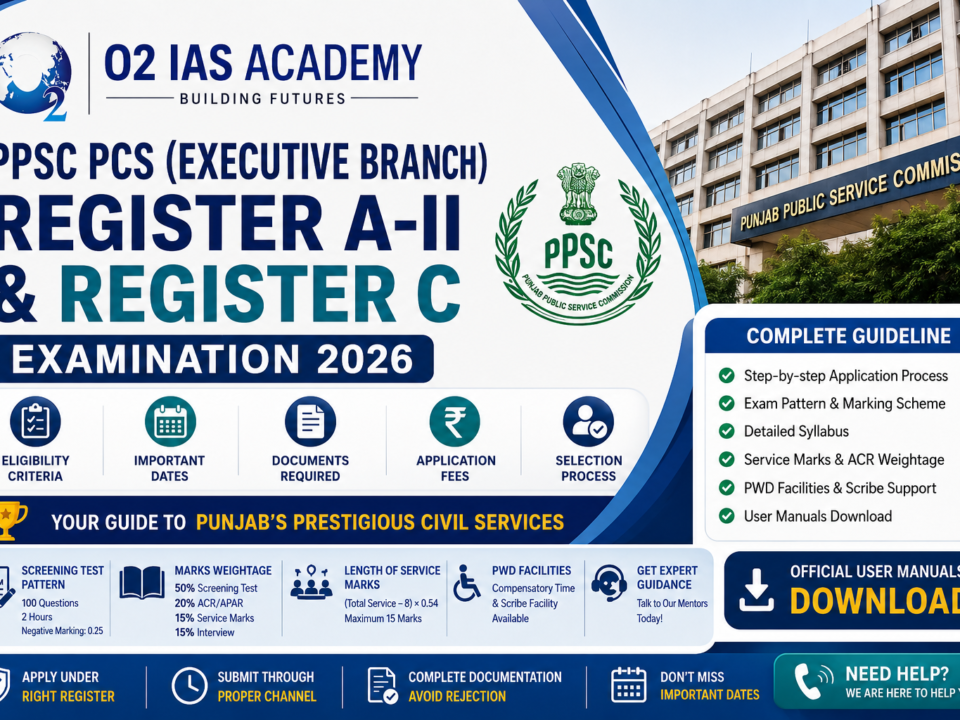
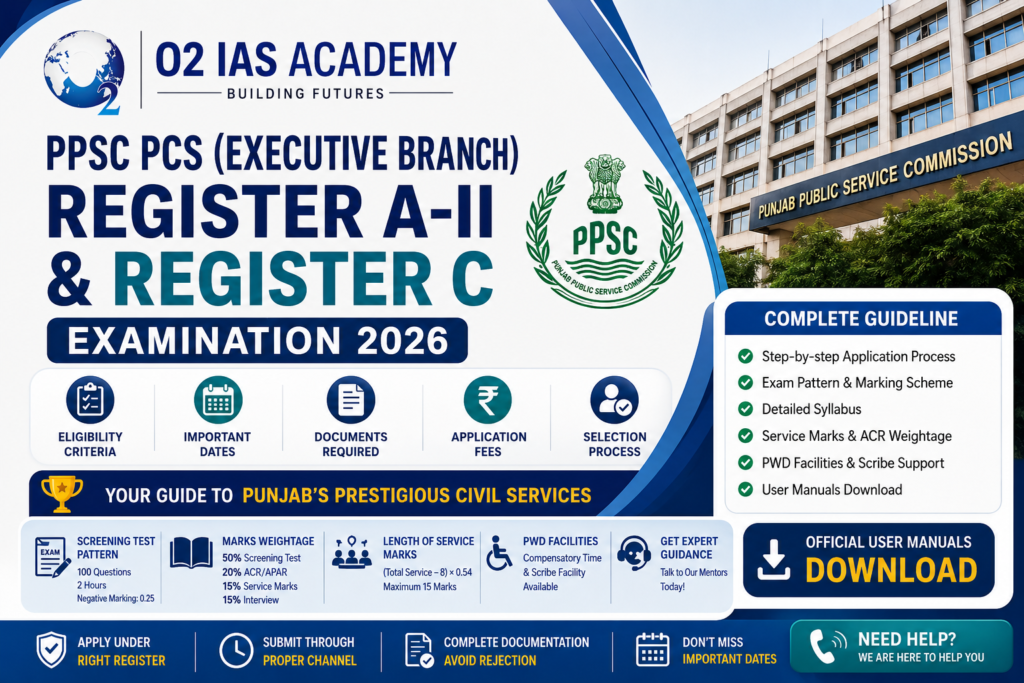
The Punjab PCS examination conducted by the Punjab Public Service Commission (PPSC) is one of the most prestigious exams in Punjab. Aspirants preparing for Punjab PCS must thoroughly understand the syllabus, as it forms the foundation of their preparation.
The Punjab PCS Syllabus 2026 offers a clear roadmap for candidates aiming for administrative positions such as SDM, DSP, Tehsildar and other allied services. A structured understanding of the syllabus ensures focused preparation instead of scattered effort.
In this guide, we will explain the Preliminary Examination, Main Examination, Interview process, marking scheme, qualifying criteria, and important highlights exactly as defined in the official notification — in simple and clear language.
Confused About Punjab PCS Syllabus or Strategy?
Speak directly with a faculty mentor and get clarity on syllabus coverage, Punjab-specific focus areas, Prelims vs Mains strategy, and how to prepare smartly for 2026.
One strategic conversation can save you months of directionless preparation.
Punjab PCS Selection Process 2026
The Punjab PCS 2026 examination is conducted in three distinct stages. Each stage serves a specific purpose in assessing a candidate’s knowledge, analytical ability, and administrative suitability.
Stage 1 – Punjab PCS Preliminary Examination
The Preliminary Examination is a screening test. It consists of objective-type papers designed to shortlist candidates for the Main Examination.
Important Points:
- Objective-type (MCQ) papers
- Qualifying in nature
- Marks are not counted in final merit
- Shortlisting for Mains based on cut-off
Stage 2 – Punjab PCS Main Examination
The Main Examination is the most crucial stage of Punjab PCS. It evaluates in-depth knowledge, analytical thinking, and answer-writing skills.
Important Points:
- Descriptive written examination
- Multiple General Studies papers
- Language papers (qualifying)
- Marks counted for final merit
Stage 3 – Punjab PCS Interview
The final stage assesses the candidate’s personality, leadership qualities, decision-making ability, and suitability for public service.
Important Points:
- Conducted by PPSC panel
- Tests administrative aptitude
- Marks added to final merit
- Final ranking based on Mains + Interview
Final Merit = Marks Obtained in Mains + Interview
Preliminary examination is qualifying and does not contribute to the final ranking.
Punjab PCS Prelims Exam Pattern 2026
The Punjab PCS Preliminary Examination is the first stage of the selection process. It is designed to shortlist candidates for the Main Examination. The exam consists of two objective-type papers.
Paper I – General Studies
Exam Structure:
- Objective Type (Multiple Choice Questions)
- Total Marks: 200
- Total Questions: 100
- Duration: 2 Hours
This paper tests the candidate’s understanding of current affairs, history, polity, economy, geography, environment, and Punjab-specific topics.
Paper II – Civil Services Aptitude Test (CSAT)
Exam Structure:
- Objective Type (Multiple Choice Questions)
- Total Marks: 200
- Total Questions: 100
- Duration: 2 Hours
- Qualifying in nature
This paper evaluates comprehension skills, logical reasoning, analytical ability, decision-making, and basic numeracy. Candidates must secure the minimum qualifying marks as prescribed by PPSC.
Important Note:
The marks obtained in the Preliminary Examination are only for screening purposes. They are not counted in the final merit list. Only marks secured in the Main Examination and Interview determine the final ranking.
Punjab PCS Prelims Syllabus 2026 (Official Structure)
The syllabus for the Punjab State Civil Services Combined Competitive Preliminary Examination is divided into two papers — Paper I (General Studies) and Paper II (Civil Services Aptitude Test). Below is the subject-wise breakdown as defined in the official notification.
Paper I – General Studies
1. Everyday Science
States of matter, structure of atom, versatile nature of carbon. Acids, bases, salts, corrosion, life processes, nutrition, diseases (infectious & lifestyle), public health initiatives, force and laws of motion, gravitation, energy, light, sound, electric current, computers and telecommunication.
2. Environmental Studies
Composition of atmosphere, solar system, climate change, greenhouse gases, biodiversity, soil, pollution, water bodies, conservation, renewable energy and related environmental concerns.
3. Political Theory & International Order
Freedom, equality, social justice, rights and duties, citizenship, nationalism, secularism. United Nations, World Bank, IMF, WTO, EU, G20, BRICS and their role in global peace and development.
4. Indian Polity
Features of the Indian Constitution, amendments, Panchayati Raj, Representation of People’s Act, electoral reforms, coalition politics, and challenges to the Indian state.
5. History of India & World History
Indus Valley Civilization, Vedic age, Maurya & Gupta, Bhakti movement, Mughal period, British rule, Indian National Movement. Renaissance, Industrial Revolution, American & French Revolution, Russian Revolution, World Wars I & II.
6. Indian Economy
Economic development (1950 onwards), Five Year Plans, LPG reforms, fiscal deficits, inflation, agriculture, poverty alleviation, employment, infrastructure and social sector development.
7. Geography
Population, migration, land & water resources, minerals, industries, sustainable development, transport, international trade and geographical issues.
8. Current Events
Current events of national and international importance.
9. Punjab (Special Emphasis)
Geography, agro-climatic regions, rivers, water sharing issues, demographics.
History – Sufi saints, Sikh rulers, British period, nationalist movement, Punjab post-independence.
Economy – Agriculture, animal husbandry, industry, public finance, cooperatives.
Paper II – Civil Services Aptitude Test (CSAT)
Areas Covered:
- Reading Comprehension (Punjabi & English)
- Interpersonal and Communication Skills
- Logical Reasoning & Analytical Ability
- Basic Numerical Skills
- Data Interpretation (Charts, Graphs, Tables)
Important Notes – Punjab PCS Preliminary Examination
The following conditions and rules govern the Punjab State Civil Services Preliminary Examination as prescribed by the Punjab Public Service Commission (PPSC).
- Both the papers shall be of objective type (multiple choice questions).
- CSAT (Paper II) shall be qualifying in nature, without negative marking, with a minimum cut-off of 40% marks.
Explanation:
- Candidates must secure at least 40% marks in Paper-II to qualify the Preliminary Examination.
- Marks obtained in Paper-II shall not be counted for determination of merit.
- Merit of the Preliminary Examination shall be based solely on Paper-I (General Studies).
- Duration of each paper shall be two hours. Persons with disabilities shall be given an additional 40 minutes per paper.
- There shall be no negative marking in the written Preliminary Examination.
- The question paper shall be bilingual — printed in English (Roman script) and Punjabi (Gurmukhi script), except where language proficiency is being tested.
- The standard of questions shall test knowledge expected of a person who has attained education at least up to graduation level.
- The Preliminary Examination is only a screening test. Marks obtained shall not be counted towards final merit after the Written Main Examination.
- Candidates equal to 12 to 13 times the number of advertised vacancies in each category shall qualify for the Main Examination, subject to availability and eligibility.
Punjab PCS Mains Exam Pattern 2026
The Main Competitive Examination is the most decisive stage of the Punjab PCS selection process. All papers are descriptive in nature and the marks obtained in Mains, along with the Interview, determine the final merit.
1. Punjabi (Compulsory – 10+2 Level)
100 Marks (Qualifying)
2. English (Compulsory – 10+2 Level)
100 Marks (Qualifying)
3. Essay
150 Marks
4. General Studies Paper I
History, Geography & Society – 250 Marks
5. General Studies Paper II
Indian Constitution, Governance & IR – 250 Marks
6. General Studies Paper III
Economy, Statistics & Security Issues – 250 Marks
7. General Studies Paper IV
Science, Technology, Environment & Decision Making – 250 Marks
Interview (Personality Test)
150 Marks – Conducted for candidates who qualify the Main Examination.
Grand Total – 1500 Marks
Final Merit Calculation
(Essay + GS Papers I–IV)
= 1350 Marks
+
Interview (Personality Test)
= 150 Marks
Total = 1500 Marks
Language papers are qualifying and their marks are NOT included in final merit.
Important Notes:
- All papers are descriptive in nature.
- Duration of each paper is 3 hours.
- Minimum 45% aggregate required to qualify (40% for SC/ST).
- Minimum 25% marks required in each paper.
- Special emphasis on Punjab’s History, Culture, Economy & Geography.
- The exam can be written in both English & Punjabi (Gurmukhi script)
Important Official Notes – Punjab PCS Main Examination
The following conditions and merit rules are officially prescribed for the Punjab State Civil Services Combined Competitive Main Examination.
Minimum Qualifying Marks
- Candidates must obtain at least 45% marks in aggregate in the Main Examination (40% for SC/ST).
- Minimum 25% marks in each paper is mandatory.
- If sufficient candidates do not obtain 45% aggregate, the Commission may lower it — but not below 40% (35% for SC/ST).
Interview Eligibility
- Only candidates qualifying the Main written examination are called for Interview.
- Maximum candidates called for Interview shall be up to three times the number of vacancies in each category.
Final Merit Calculation
Final merit is prepared based on the aggregate marks obtained in:
- Main Written Examination (Essay + GS Papers I–IV)
- Interview (Personality Test)
Language papers (Punjabi & English) are qualifying only and are not counted in final merit.
Tie-Breaking Rule (If Marks Are Equal)
- Candidate securing higher marks in the written part of Main Examination ranks higher.
- If still equal, candidate securing higher aggregate in General Studies Papers (I–IV) ranks higher.
- If still equal, the older candidate (by age) ranks higher.
Punjab PCS Mains GS–I
HISTORY, GEOGRAPHY AND SOCIETY
Section – 1: HISTORY
- History of the world: Events from 18th century; industrial revolution, world wars, redrawal of national boundaries, colonization, decolonization, political philosophies like Communism, Capitalism, Socialism etc. – their forms and effect on society.
- Indian culture: Salient aspects of Art Forms, Literature and Architecture from ancient to modern times.
- Modern Indian history from the middle of the eighteenth century until the present – significant events, personalities and issues.
- Socio-religious reform movements with special reference to Punjab.
- The Freedom Struggle – its various stages and important contributors/contributions from different parts of the country with special reference to Punjab.
- Post-independence consolidation and reorganization within the country.
- History of Punjab:
- Ranjit Singh’s rise to power, civil and military administration and relations with the British.
- Annexation of Punjab with special reference to the causes and consequences of the Anglo-Sikh wars.
Section – 2: GEOGRAPHY
- Physical Geography: Salient features of world’s physical geography. Distribution of key natural resources across the world (including South Asia and the Indian subcontinent); factors responsible for the location of primary, secondary, and tertiary sector industries in various parts of the world (including India).
- Important Geophysical phenomena such as earthquakes, Tsunami, Volcanic activity, cyclone etc., geographical features and their location – changes in critical geographical features (including water-bodies and ice-caps) and in flora and fauna and the effects of such changes.
- Geography of Punjab:
- Physiographic details of Punjab; Geomorphic features of Punjab; Punjab’s strategic location with reference to International Border.
- Crops of Punjab; Modern concepts of Farming; Problems faced by agriculturists/Issues in Agriculture: Depletion of ground water, etc.
Section – 3: SOCIETY
- Salient features of Indian Society, Diversity of India.
- Role of women and women’s organization, population and associated issues, poverty and developmental issues, urbanization, their problems and their remedies.
- Effects of globalization on Indian society.
- Social empowerment, communalism, regionalism & secularism.
- Ethics and Society: Essence, determinants and consequences of Ethics in human actions; dimensions of ethics; ethics in private and public relationships.
- Human Values: Role of family, society and educational institutions in inculcating values; lessons from the lives and teachings of great leaders and reformers – Gautam Buddha, Mahavira, Kabir, Guru Nanak; Swami Vivekananda, Jyotibha Phule, Ishwar Chandra Vidya Sagar and Mahatma Gandhi.
- Vulnerable sections of the population – Welfare schemes by the Centre and State of Punjab and their performance; Mechanisms, laws, institutions and Bodies constituted for their protection and betterment.
- Issues relating to development and management of Social Sector – Health, Education, Human Resources; Issues relating to Poverty and Malnutrition.
Punjab PCS Mains GS–II
INDIAN CONSTITUTION & POLITY, GOVERNANCE AND INTERNATIONAL RELATIONS
Section – 1: INDIAN CONSTITUTION & POLITY
- Indian Constitution – historical underpinnings, evolution, features, amendments, significant provisions and basic structure.
- Functions and responsibilities of Union and the States, issues and challenges pertaining to the federal structure, devolution of powers and finances up to local levels and challenges therein.
- Separation of powers between various organs; Dispute redressal mechanisms and institutions.
- Comparison of the Indian constitutional scheme with that of other countries.
- Parliament and State Legislatures – structure, functioning, conduct of business, powers & privileges and issues arising out of these.
- Structure, organization and functioning of the Executive and the Judiciary; Ministries and Departments of the Government; pressure groups and formal/informal associations and their role in the Polity.
- Salient features of the Representation of People’s Act.
- Appointment to various Constitutional posts; Powers, functions and responsibilities of various Constitutional Bodies.
- District Administration – Evolution of District Administration; Panchayati Raj Institutions and Urban Local Bodies.
Section – 2: GOVERNANCE
- Statutory, regulatory and various quasi-judicial bodies.
- Government policies and interventions for development in various sectors and issues arising out of their design and implementation; Development processes and the development organizations – the role of NGOs, SHGs, donors, charities, institutional and other stakeholders.
- Important aspects of governance, transparency and accountability, e-governance applications, models, successes, limitations and potential; citizens charters, transparency & accountability and institutional and other measures; Role of civil services in a democracy; Changing trends in Governance.
- Values and Ethics in Governance – Ethical concerns and dilemmas in government and private institutions; laws, rules, regulations and conscience as sources of ethical guidance; accountability and ethical governance; strengthening of ethical and moral values in governance; ethical issues in international relations and funding.
- Probity in Governance: Concept of Governance; Philosophical basis of governance and probity; corporate governance; Information sharing and transparency in government, Right to Information, Codes of Ethics, Codes of Conduct, Citizen’s Charters, Work culture, Quality of service delivery, Utilization of public funds, challenges of corruption.
Section – 3: INTERNATIONAL RELATIONS
- India and its neighborhood – relations.
- Bilateral, regional and global groupings and agreements involving India and/or affecting India’s interests.
- Effect of policies and politics of developed and developing countries on India’s interests, Indian Diaspora.
- Important International institutions, agencies and fora – their structure and mandate.
Note: The candidates are expected to be aware about the current developments related to the above topics.
Punjab PCS Mains GS – III
ECONOMY, STATISTICS AND SECURITY ISSUES
Section – 1: Indian Economy
- Issues relating to planning, mobilization of resources, growth, development and employment; sustainable development; Inclusive growth and issues arising from it; Government Budgeting.
- Major crops, cropping patterns in various parts of the country, different types of irrigation and irrigation systems; storage, transport and marketing of agricultural produce – issues and related constraints; e-technology in the aid of farmers; Issues related to direct and indirect farm subsidies and minimum support prices; Technology missions; economics of animal rearing.
- Public Distribution System – objectives, functioning, limitations, revamping; issues of buffer stocks and food security.
- Food processing and related industries in India – scope and significance, location, upstream and downstream requirements, supply chain management.
- Land reforms in India; Effects of liberalization on the economy, changes in industrial policy and their effects on industrial growth.
- Infrastructure – Energy, Ports, Roads, Airports, Railways etc.; Investment models.
- Human Resource Development:
- Importance of Human capital in economic development.
- Nature, types and problems of unemployment in India, Trends of Employment in India, Skill development and demographic dividend.
- Punjab Economy: Planning – various aspects of developmental planning; Industry; Infrastructure.
Section – 2: Statistical Analysis, Graphs and Diagrams
This part will test the candidate’s ability to draw conclusions from information presented in statistical, graphical or diagrammatical form and to interpret the same.
Section – 3: Issues related to Security
- Linkages between development and spread of extremism.
- Role of external, State and non-State actors in creating challenges to internal security; Challenges to internal security through communication networks; role of media and social networking sites in internal security challenges.
- Basics of cyber security; money-laundering and its prevention.
- Security challenges and their management in border areas; linkages of organized crime with terrorism.
- Various Security forces and agencies and their mandate.
Note: The candidates are expected to be aware about the current developments related to the topics mentioned above.
Punjab PCS Mains GS–IV
SCIENCE & TECHNOLOGY, ENVIRONMENT, PROBLEM SOLVING & DECISION MAKING
Section – 1: Science and Technology
-
Science and Technology
- Developments and applications of science and technology and their effects in everyday life.
- Achievements of Indians in science & technology; indigenization of technology and developing new technology.
- Recent developments in the fields of IT, Space, Computers, robotics, nanotechnology, etc.
- Issues relating to intellectual property rights.
-
Modern Trends in Life Sciences
- Progress of Agricultural Science and its impact – Introduction to Biotechnology and its applications; Veterinary and Animal Sciences – latest developments.
- Introduction to and applications of Genetic Engineering & Stem Cell Research.
- Human Diseases and Microbial infections; Common infections and preventive measures; preventive measures during outbreaks; Immunity and vaccination.
Section – 2: Environment
- Conservation, environmental pollution and degradation, Issues related to Climate change; environmental impact assessment.
- Water management – Issues in India; Present scenario, Methods and importance of water conservation.
- Definition, nature, types and classification of disasters.
- Natural Hazards: Floods, earthquakes, tsunamis, landslides, etc., Risk reduction and mitigation measures.
Section – 3: Situations in Civil Service – Problem Solving and Decision Making
- Tackling situations of Natural disasters/ Major Accidents/ Law and order, Controlling riots, Handling public protests and dharnas, Land Acquisition and Rehabilitation, Designing Projects.
- Implementation of National Flagship Schemes/ Programmmes, Public Private Partnership in effective service delivery, Managing and financing Municipal services e.g. Solid waste management, Conservation of natural resources – water, forests, etc., Pollution control, Reviving a loss making PSU, Planning and target achievement, Gender sensitization and women empowerment, Empowerment of vulnerable sections of the society, Improving Education and Enhancing Skill development, Urban settlement – Slums and Housing issues, Managing Issues related to Urban/ Rural drinking water supply and sanitation, etc.
Punjab PCS Mains – Compulsory Language Papers
The Punjab PCS Mains Examination includes two qualifying language papers. These papers are mandatory, but the marks obtained in them are not counted for final merit ranking.
Paper I – Punjabi (Gurmukhi Script)
This paper tests the candidate’s proficiency in Punjabi language written in Gurmukhi script.
Areas Covered:
- Comprehension of given passages.
- Translation from English to Punjabi.
- Translation from Punjabi to English.
- Grammar and usage.
- Essay writing in Punjabi.
Paper II – English
This paper evaluates the candidate’s command over English language and ability to express ideas clearly and effectively.
Areas Covered:
- Comprehension of passages.
- Precis writing.
- Essay writing.
- Grammar and usage.
- Translation and vocabulary-based exercises.
Important: Candidates must secure the minimum qualifying marks prescribed by the Commission in both language papers. Failure to qualify in either paper will disqualify the candidate from evaluation of other Mains papers.
Punjab PCS Mains – Essay Paper
The Essay Paper in Punjab PCS Mains carries 250 Marks and plays a crucial role in determining the final merit ranking. It tests clarity of thought, depth of understanding, structure of argument, and the candidate’s ability to present ideas in a coherent manner.
Essay Paper – 250 Marks
- Candidates are required to write essays on given topics.
- Topics may relate to current affairs, social issues, political themes, economic matters, philosophical ideas, or Punjab-specific concerns.
- Essays must demonstrate logical organization, analytical depth, and balanced viewpoints.
- Clarity, coherence, language command and originality of thought are evaluated.
What the Commission Evaluates
- Understanding of the topic.
- Ability to critically analyse issues.
- Balanced argumentation.
- Structured introduction, body and conclusion.
- Relevance to Punjab and national context where applicable.
Note: Since the Essay Paper carries significant weightage, consistent practice and structured writing preparation are essential for securing high marks in Punjab PCS Mains.
Punjab PCS Prelims vs UPSC Prelims Syllabus – Key Differences
There are two key differences:
- Punjab GK: Punjab PCS Prelims includes a dedicated focus on Punjab-specific General Knowledge (History, Culture, Geography, Economy), which is absent in UPSC.
- Political Theory and International Order: Punjab PCS Prelims uniquely mentions Political Theory concepts separately in Prelims, making it a slight addition compared to UPSC.
- World History:
- Punjab PCS: World History topics like Renaissance, Industrial Revolution, etc. are included in Prelims.
- UPSC: World History is NOT asked in Prelims; it is part of the UPSC Mains GS-1 syllabus only.
Also, in Punjab PCS, there is no separate focus on South Indian history as seen sometimes in UPSC.
Conclusion:
➡️ 80-90% syllabus overlap between Punjab PCS and UPSC Prelims.
➡️ Punjab GK, Political Theory and World History are the extra areas Punjab PCS aspirants must cover carefully.
🔍 Punjab PCS Mains vs UPSC Mains Syllabus – Key Differences
| Aspect | PPSC PCS | UPSC CSE |
|---|---|---|
| Optional Subjects | No Optional Papers | One Optional Subject (2 Papers) |
| State-Specific Topics | Yes (Punjab history, culture, economy) | No (Pan-India Focus) |
| Language Papers | Punjabi (Mandatory) + English | Indian Language + English |
Confused About Punjab PCS Preparation?
Get a personalised strategy session with our mentors. Whether it’s Prelims, Mains, Optional selection, or Answer Writing — we will guide you step-by-step.
Talk to a Teacher
Fill the form below and our team will contact you shortly.
100% Confidential • No Spam • Expert Academic Guidance
Punjab PCS 2026 Preparation Resources
Serious preparation begins with mastering the official syllabus and then applying it through Previous Year Questions (PYQs). Use both strategically to maximise your score.
Smart Strategy: First understand the syllabus → Then solve PYQs topic-wise → Identify weak areas → Revise strategically.