Why Most Engineering Graduates Choose Humanities Optionals for UPSC
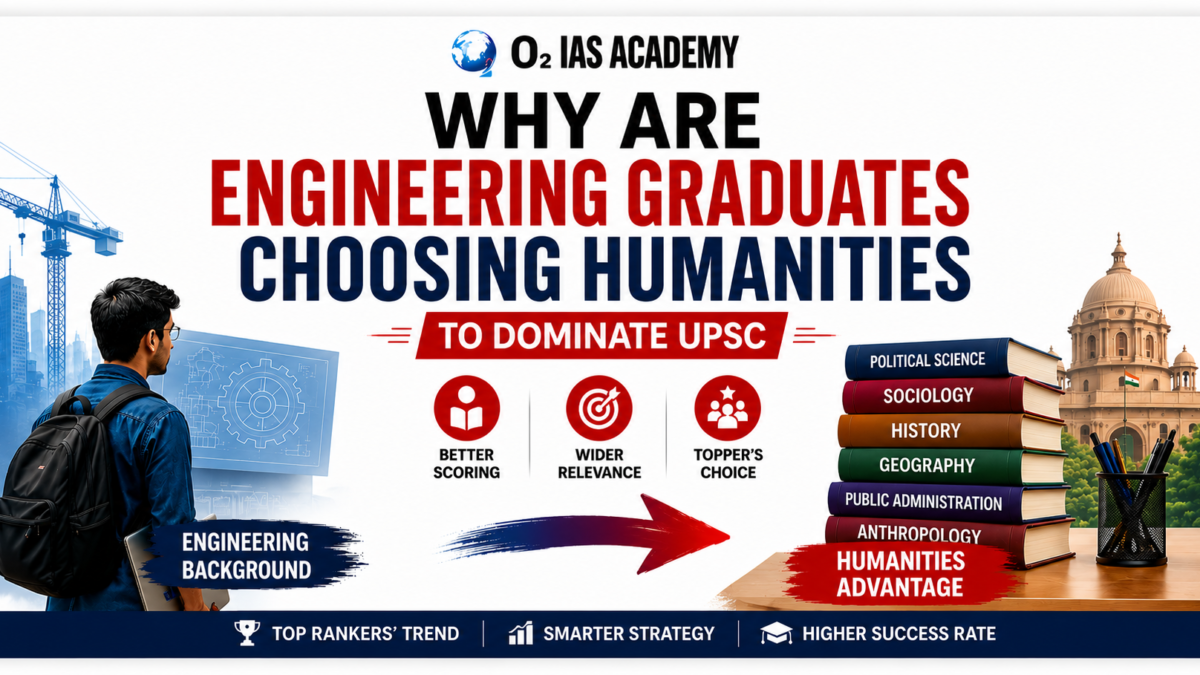
Engineering Graduates Dominate UPSC — So Why Are They Choosing Humanities Optional Subjects?
The curious story behind why thousands of engineering graduates preparing for UPSC are moving away from technical subjects and choosing Sociology, Political Science, Geography, History, Public Administration, Anthropology, and other non-technical optionals instead.
“At O2 IAS Academy, we've observed the same pattern among engineering graduates preparing from Punjab, Haryana, Himachal Pradesh, and Jammu & Kashmir — many walk in assuming they'll pick a technical optional, and by the second month of foundation classes, they're asking about PSIR or Sociology instead.”
Today, engineering graduates form one of the largest groups among UPSC aspirants and successful candidates.
Walk into any serious library in Rajinder Nagar or Mukherjee Nagar, and you will find students from IITs, NITs, private engineering colleges, and state universities preparing for the same dream.
But over the last few years, something important has quietly changed. While engineers continue to dominate UPSC selections, many of them are no longer choosing engineering subjects as their optional papers. Instead, they are moving toward subjects like:
- Sociology
- Political Science and International Relations (PSIR)
- Geography
- History
- Public Administration
- Anthropology
The shift is no longer just a small trend discussed inside coaching classrooms. It has now become one of the biggest changes in UPSC preparation culture. And the numbers clearly show it.
According to data shared by the Parliamentary Standing Committee and widely reported by The Economic Times , the share of candidates with Humanities backgrounds among those called for the personality test increased from 20.59% in 2019 to 34.41% in 2025.
Among finally recommended candidates, the proportion rose from 24.19% to 35.28% during the same period, according to the UPSC trend report published by The Economic Times .
At the same time, the share of candidates from Science and Technology backgrounds — including engineering, science, and medical disciplines — declined from 79.41% to 65.59% among personality test candidates and from 75.81% to 64.72% among final selections.
The trend has become impossible to ignore. And naturally, it raises an important question. Why are engineering graduates moving away from the very subjects they spent four years studying?
Engineering Graduates in UPSC — Why Engineers Are Avoiding Engineering Optionals
One detail from the UPSC data stands out more than anything else. Engineering graduates still remain the single largest educational group among successful candidates. In 2025 alone, 47% of the recommended candidates came from engineering backgrounds, according to the Economic Times UPSC analysis .
But when it comes to optional subjects, the picture changes completely. Humanities subjects accounted for nearly 84% of all optionals chosen by successful candidates, compared with just:
- 2% for engineering and technology
- 11% for science
- 3% for medical subjects
According to UPSC data on the Top 50 rank holders in 2025, only one out of 16 engineering graduates in the Top 50 chose an engineering optional.
Back in 2016, 36 engineering graduates featured in the Top 50, but only five retained engineering as their optional subject.
“You studied engineering and still chose a Humanities optional?”
That question quietly follows thousands of UPSC aspirants every year.
| UPSC Trend Insight | Data / Observation |
|---|---|
| Engineering graduates among recommended candidates (2025) | 47% |
| Humanities optionals chosen by successful candidates | 84% |
| Engineering & Technology optionals chosen | 2% |
| Science optionals chosen | 11% |
| Medical optionals chosen | 3% |
| Engineering graduates in UPSC Top 50 (2025) | 16 Candidates |
| Engineering graduates in Top 50 choosing engineering optional | Only 1 Candidate |
| Humanities background candidates called for interview (2019) | 20.59% |
| Humanities background candidates called for interview (2025) | 34.41% |
| Humanities background among final selections (2019 → 2025) | 24.19% → 35.28% |
Best Optional Subjects for UPSC 2026
One of the most searched questions among aspirants every year is:
“Which is the best optional subject for UPSC?”
The answer is rarely the same for everyone.
There is no universally perfect optional subject in UPSC preparation.
The best optional subject for UPSC 2026 depends on:
- your interest in the subject
- overlap with General Studies
- answer-writing comfort
- availability of guidance and resources
- consistency over long preparation cycles
Popular UPSC Optional Subjects Among Aspirants
- Sociology — concise syllabus with strong essay overlap
- PSIR — governance and current affairs relevance
- Geography — balanced conceptual and analytical subject
- Anthropology — concise syllabus with diagram-based answers
- Public Administration — administration and governance overlap
- History — useful for culture and General Studies preparation
Subjects like Anthropology, Sociology, PSIR, and Geography are often considered scoring because of their manageable syllabus, overlap with GS and Essay, answer-writing flexibility, and consistent performance trends.
UPSC Preparation Changes the Way Aspirants Think
Most engineering graduates enter UPSC preparation believing the exam is mainly about intelligence and hard work.
Months later, many realise something unexpected.
UPSC is not just testing knowledge.
It is testing understanding.
Understanding Society, Governance & Ethics
- society
- governance
- ethics
- human behaviour
- decision-making
- communication
- balanced thinking
Political Science helps in governance and international relations.
Geography overlaps with environment and current affairs.
Sociology improves understanding of social issues, essays, and interviews.
Preparation starts connecting with itself.
An aspirant studying one paper indirectly improves preparation for several others.
UPSC Optional Overlap with GS, Essay & Ethics
One of the biggest reasons Humanities optionals became popular is simple: overlap.
In UPSC preparation, overlap saves time, revision energy, and mental bandwidth.
- General Studies preparation
- Essay writing
- Ethics paper understanding
- Interview preparation
- Current Affairs analysis
A growing number of engineering graduates preparing for UPSC now actively explore Humanities optionals because of their overlap, answer-writing flexibility, and long-term preparation sustainability.
How to Decide If a Humanities Optional Is Right for You
Before choosing any UPSC optional subject, aspirants should evaluate a few practical factors honestly.
1. Do You Enjoy Analytical Writing?
Humanities optionals reward interpretation, balanced arguments, and multidimensional analysis.
2. Do You Want Strong Overlap with GS, Essay & Ethics?
Subjects like Geography, Sociology, Anthropology, and PSIR often support multiple parts of UPSC preparation simultaneously.
3. Can You Stay Consistent with Revision?
The best optional subject is often the one you can revise repeatedly without burnout.
4. Are You Choosing the Subject for the Right Reasons?
Do not choose an optional only because it is considered “high scoring.” Choose one that remains sustainable throughout your UPSC journey.
Frequently Asked Questions About UPSC Optional Subjects
Which optional subject is best for UPSC in 2026?
The right optional depends on interest, answer-writing ability, overlap with GS, and long-term consistency.
Which optional subject is considered most scoring in UPSC?
Anthropology, Sociology, PSIR, and Geography are often considered among the most scoring optional subjects.
Why is Anthropology considered one of the most scoring optional subjects in UPSC?
Anthropology is considered scoring because of its concise syllabus, scientific structure, and revision-friendly preparation.
UPSC Optional Subject Strategy for Engineering Graduates
- Prioritise overlap over familiarity — choose subjects that support GS, Essay, Ethics, and Interview preparation simultaneously.
- Evaluate answer-writing comfort honestly — UPSC rewards analytical and multidimensional writing more than technical precision.
- Choose a revision-friendly syllabus — optional subjects requiring manageable revision cycles often help maintain consistency during long preparation phases.
- Do not select an optional only because of your degree — engineering background does not automatically make engineering optionals the best choice for UPSC.
- Focus on long-term sustainability — pick a subject you can study continuously for months without burnout or loss of interest.
- Check guidance and resource availability — quality mentorship, PYQs, test series, and answer-writing support significantly affect optional preparation.
- Study previous year papers before deciding — analysing actual UPSC questions gives a clearer understanding of the subject’s demand and writing style.
- Think beyond scoring trends — the best optional is usually the one you understand deeply and can write confidently in the examination hall.
Still Confused About Which UPSC Optional Subject to Choose?
Get expert mentorship, optional subject guidance, and preparation strategy support from O2 IAS Academy.